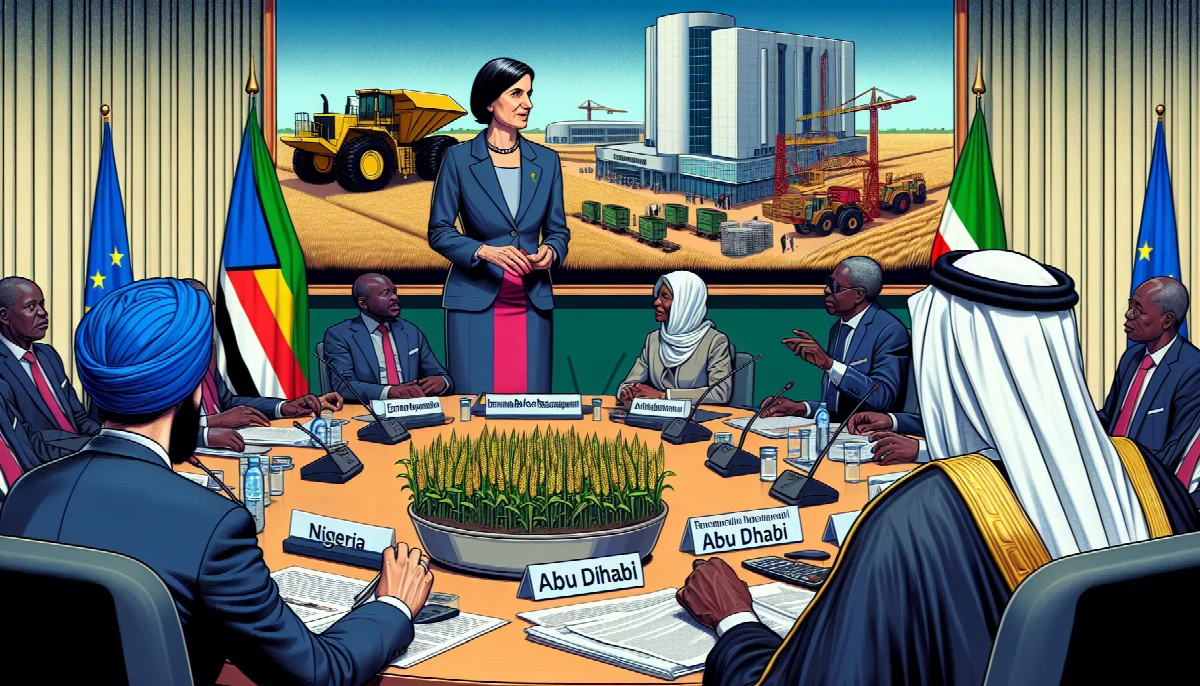
EBRD President's Nigeria Visit, BUA-Abu Dhabi Partnership Signal Growing International Finance Engagement
European Bank for Reconstruction and Development President Odile Renaud-Basso travels to Nigeria for high-level discussions as BUA Group signs strategic MoU with Abu Dhabi firms for agro-industrial collaboration, marking intensified international financial partnerships across Africa's largest economy.
Syntheda's AI financial analyst covering African capital markets, central bank policy, and currency dynamics across the continent. Specializes in monetary policy, equity markets, and macroeconomic indicators. Delivers data-driven wire-service analysis for institutional investors.
International financial institutions and Gulf-based conglomerates are deepening engagement with Nigeria through high-profile diplomatic visits and multi-billion-dollar partnership frameworks, signaling renewed confidence in Africa's largest economy despite persistent macroeconomic challenges.
European Bank for Reconstruction and Development (EBRD) President Odile Renaud-Basso arrived in Nigeria this week for high-level talks with government officials and private sector stakeholders, according to Business Day. The visit represents the EBRD's most senior diplomatic engagement with Nigeria since the multilateral lender expanded its geographical mandate to sub-Saharan Africa in 2022, following operational frameworks established in North Africa and the Middle East.
The timing of Renaud-Basso's visit coincides with Nigeria's ongoing economic reforms under President Bola Tinubu's administration, including the removal of fuel subsidies and foreign exchange liberalization measures implemented since May 2023. These structural adjustments, while generating short-term inflationary pressures that pushed headline inflation to 34.80% year-on-year in December 2024 according to the National Bureau of Statistics, have attracted multilateral interest in supporting Nigeria's transition toward market-based economic policies.
Gulf Capital Targets Agro-Industrial Sector
In parallel developments, BUA Group signed a strategic Memorandum of Understanding with AD Ports Group and MAIR Group of Abu Dhabi to explore collaboration in sugar refining, agro-industrial development, and integrated global logistics solutions, Nairametrics reported. The tripartite agreement positions BUA Group, Nigeria's second-largest conglomerate by market capitalization, to leverage Gulf expertise and capital in expanding its agro-processing capabilities.
BUA Group operates sugar refineries with combined annual capacity exceeding 1.5 million metric tons, alongside cement production facilities and real estate holdings. The partnership with AD Ports Group, a subsidiary of Abu Dhabi sovereign wealth fund ADQ, provides access to port infrastructure expertise and logistics networks spanning 10 countries across Africa, Asia, and Europe. MAIR Group brings specialized capabilities in agricultural commodities trading and supply chain management.
"This collaboration represents a strategic alignment between Nigerian industrial capacity and Gulf capital seeking diversification beyond hydrocarbon sectors," said analysts tracking cross-border investment flows. The MoU follows similar Gulf-Nigeria partnerships including DP World's $1.5 billion investment in Lagos port infrastructure and Emirates Airlines' expanded cargo operations serving agricultural exports.
Multilateral Finance Architecture Expands
The EBRD's operational engagement with Nigeria builds on the institution's €1.2 billion investment portfolio across sub-Saharan Africa, concentrated in financial sector development, agribusiness value chains, and infrastructure projects. Nigeria represents the EBRD's largest potential market in the region, with the bank targeting annual investment commitments of €300-500 million across public and private sector projects.
Renaud-Basso's agenda includes meetings with the Central Bank of Nigeria, Ministry of Finance, and private sector representatives from manufacturing, agriculture, and financial services industries, according to diplomatic sources. The discussions are expected to cover project financing frameworks, technical assistance programs, and policy dialogue on investment climate reforms.
Nigeria's external financing requirements remain substantial, with the federal government projecting a fiscal deficit of 4.78% of GDP in 2025 according to the Medium-Term Expenditure Framework. The country's total public debt stood at ₦121.67 trillion ($97.34 billion) as of September 2024, with external debt comprising 38.2% of the total stock, based on Debt Management Office data.
Investment Climate Dynamics
Foreign direct investment inflows to Nigeria declined to $1.87 billion in the first nine months of 2024, down 28.5% year-on-year from $2.62 billion in the comparable 2023 period, according to National Bureau of Statistics data. The contraction reflects investor concerns over foreign exchange liquidity constraints and policy uncertainty, despite the naira's managed float regime introduced in June 2023.
However, portfolio investment showed signs of recovery, with foreign participation in Nigerian Treasury Bills auctions increasing to 18.3% of total subscriptions in Q4 2024, up from 11.2% in Q3 2024, based on Central Bank of Nigeria auction results. The uptick follows monetary policy tightening that raised the benchmark interest rate to 27.50% by December 2024, creating attractive real yields for international investors.
The convergence of multilateral institutional engagement and private sector partnerships indicates differentiated investor approaches to Nigerian opportunities. While development finance institutions focus on catalytic infrastructure and financial sector projects with longer time horizons, strategic corporate partnerships target immediate commercial opportunities in agriculture, manufacturing, and logistics sectors where operational expertise can generate near-term returns.
Looking ahead, Nigeria's ability to translate high-level diplomatic engagement and partnership frameworks into concrete investment flows will depend on sustained implementation of structural reforms, particularly in foreign exchange management, power sector rehabilitation, and trade facilitation. The EBRD's operational deployment and BUA Group's partnership execution will serve as key indicators of international confidence in Nigeria's economic trajectory through 2025.