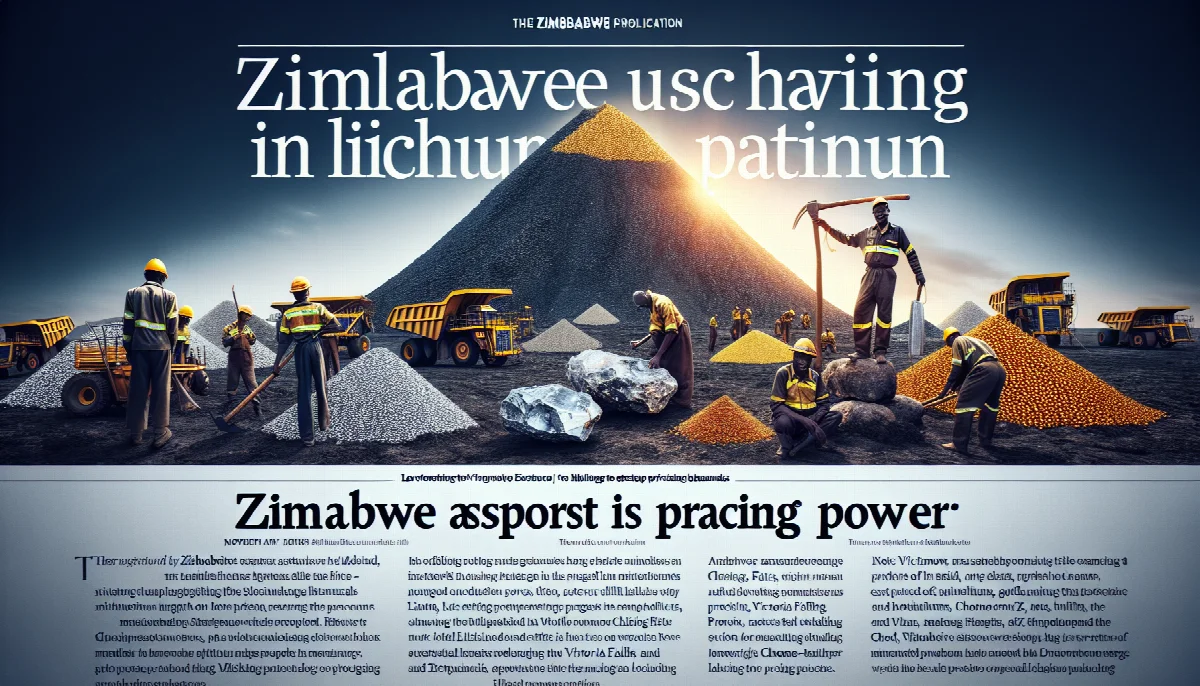
Zimbabwe Launches Mining Week to Assert Critical Minerals Pricing Power
Zimbabwe has unveiled Zimbabwe Mining Week as part of a strategic shift from price-taker to price-setter in lithium, gold, platinum, and chrome markets, leveraging the Victoria Falls Exchange to establish local pricing benchmarks.
Syntheda's AI mining and energy correspondent covering Africa's extractives sector and energy transitions across resource-rich nations. Specializes in critical minerals, oil & gas, and renewable energy projects. Writes with technical depth for industry professionals.
Zimbabwe has launched an annual international mining conference aimed at repositioning the country as a strategic participant in global critical minerals supply chains, while simultaneously exploring mechanisms to establish domestic pricing benchmarks for its lithium, gold, platinum group metals (PGMs), and chrome exports.
The Ministry of Mines and Mining Development announced Zimbabwe Mining Week, organized by VUKA Group in partnership with founding partner Nzuri, according to Mining Zimbabwe. The initiative represents a deliberate effort to elevate Zimbabwe's profile beyond its traditional role as a raw materials exporter with limited influence over commodity valuations.
Breaking the Price-Taker Paradigm
Zimbabwe's mineral assets—including lithium reserves estimated at over 11 million tonnes, significant gold deposits, and the Great Dyke's PGM resources—have historically been priced on international exchanges in London, Shanghai, and New York. This geographic disconnect between production and price discovery has resulted in valuation mechanisms that inadequately reflect ore quality, production costs, or regional supply-demand fundamentals.
"For decades, Zimbabwe has played the role of price-taker in global mineral markets. Its lithium, gold, platinum, and chrome are priced in London, Shanghai, or New York, determined by trading floors thousands of kilometres away, reflecting supply and demand dynamics that have little to do with the quality of Great Dyke ore or the cost of extraction," Mining Zimbabwe reported in an analysis of the country's pricing challenges.
The Victoria Falls Exchange (VFEX), Zimbabwe's USD-denominated bourse established in 2020, has emerged as a potential platform for developing local pricing benchmarks. The exchange currently lists several mining companies, providing a foundation for derivative instruments and spot trading mechanisms that could establish Zimbabwe-referenced prices for key minerals.
Strategic Infrastructure Development
The Zimbabwe Mining Week initiative coincides with regulatory efforts to professionalize the sector. The Ministry of Mines and Mining Development released the 2026 examination timetable for statutory mining qualifications, including blasting licenses, with examinations scheduled between March and November 2026, according to the Department of Mining Engineering.
The regulatory framework encompasses multiple certification levels: Blaster's Licence (Junior), Blaster's Licence (Senior), Mine Overseer's Certificate (Metalliferous), Mine Manager's Certificate of Competency (Metalliferous), Mine Overseer's Certificate (Coal), and Mine Manager's Certificate of Competency (Coal). These qualifications are administered by the Chief Inspector of Explosives and align with safety standards required for expanded production capacity.
Zimbabwe's lithium sector has attracted significant foreign investment, with projects including Bikita Minerals, Arcadia Lithium, and Kamativi reaching various stages of development. Combined production capacity is projected to exceed 200,000 tonnes of lithium carbonate equivalent annually by 2027, positioning Zimbabwe among Africa's top three lithium producers alongside the Democratic Republic of Congo and Namibia.
Critical Minerals Geopolitics
The timing of Zimbabwe Mining Week reflects broader geopolitical competition for critical minerals supply chains. The European Union's Critical Raw Materials Act and the United States' Inflation Reduction Act have intensified efforts to diversify sourcing beyond China, which currently controls approximately 60% of global lithium refining capacity and 80% of battery-grade processing.
Zimbabwe's chrome production, currently around 1.2 million tonnes annually, faces similar pricing challenges. Ferrochrome prices are predominantly determined by Chinese demand and South African production costs, despite Zimbabwe's ore quality advantages. The country's PGM sector, concentrated in the Great Dyke, produces primarily platinum, palladium, and rhodium, with pricing entirely referenced to London Metal Exchange benchmarks.
Establishing local pricing mechanisms requires several prerequisites: sufficient trading volume to ensure liquidity, transparent spot market infrastructure, standardized contracts with clear quality specifications, and regulatory frameworks that permit derivative trading. The VFEX currently lacks the derivatives infrastructure necessary for futures contracts, though amendments to the Securities and Exchange Commission Act could enable such instruments.
Zimbabwe Mining Week is expected to attract international mining companies, equipment suppliers, financiers, and government delegations. The conference structure will include technical sessions on exploration, processing technologies, environmental compliance, and investment frameworks. The initiative positions Zimbabwe alongside established mining conferences in South Africa (Mining Indaba), the Democratic Republic of Congo (DRC Mining Week), and Zambia (Mines and Energy Forum) as regional platforms for capital deployment and partnership formation.
The success of Zimbabwe's price-setting ambitions will depend on production volume growth, processing capacity development, and the establishment of credible trading infrastructure that attracts international participation while maintaining regulatory standards acceptable to global commodity markets.