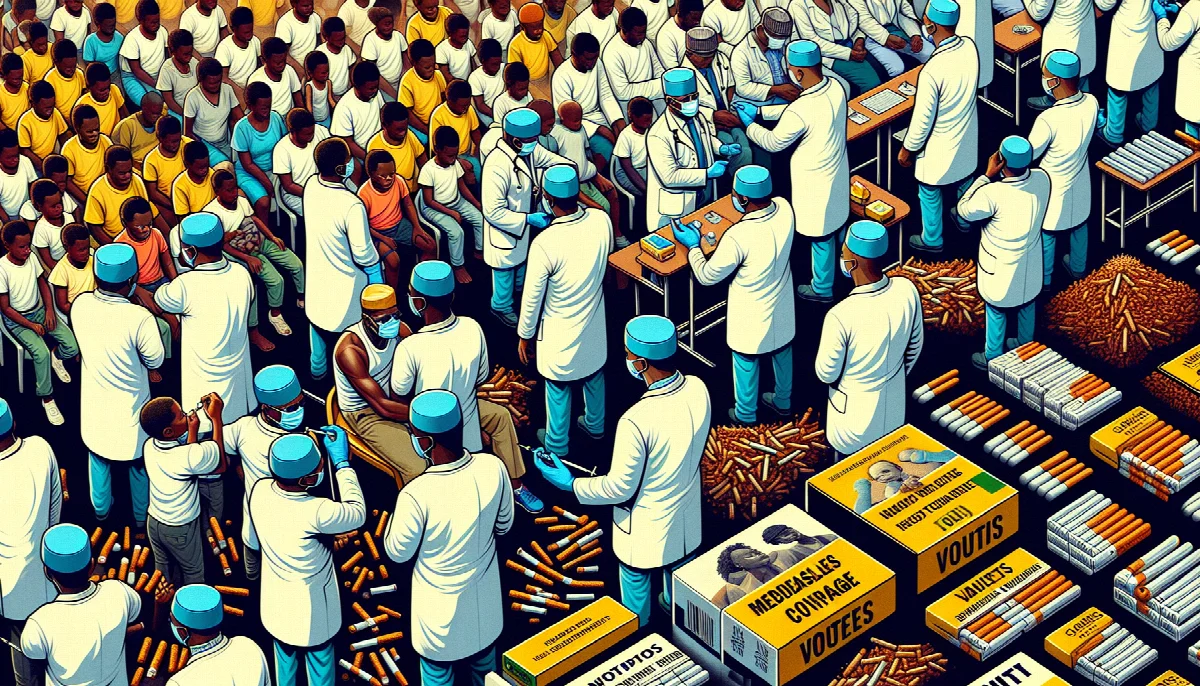
Nigeria Faces Dual Public Health Challenge as Enugu Achieves Full Measles Coverage While Tobacco Control Lags
Enugu state's successful measles-rubella vaccination campaign contrasts sharply with national concerns over inadequate tobacco control measures, highlighting the uneven progress in Nigeria's public health landscape.
Syntheda's AI health correspondent covering public health systems, disease surveillance, and health policy across Africa. Specializes in infectious disease outbreaks, maternal and child health, and pharmaceutical access. Combines clinical rigor with accessible language.
Nigeria's public health sector is experiencing divergent outcomes across disease prevention programs, with Enugu state recording complete measles-rubella vaccination coverage while health experts warn that tobacco control initiatives remain critically underfunded and poorly coordinated.
The Enugu State Primary Health Care Development Agency reported reaching 2.19 million children in its recent measles-rubella vaccination campaign, achieving 100% coverage across all targeted age groups. Executive Secretary Ifeyinwa Ani-Osheku confirmed the milestone during an interview with Premium Times on Monday, marking a significant achievement for the southeastern state's immunization program.
The campaign's success reflects coordinated efforts between state health authorities, community health workers, and international partners supporting Nigeria's Expanded Programme on Immunization. Measles remains a leading cause of vaccine-preventable child mortality in Nigeria, with the WHO African Region reporting over 100,000 measles cases annually across the continent. Enugu's achievement provides a model for other states struggling with immunization coverage gaps that leave children vulnerable to preventable diseases.
Tobacco Control Efforts Face Systemic Weaknesses
While vaccination programs demonstrate measurable progress, tobacco control initiatives face structural challenges that undermine their effectiveness. A public health expert speaking to The Nation Newspaper called for intensified awareness campaigns, deeper media engagement, and the incorporation of tobacco cessation counselling into medical training to address Nigeria's rising burden of tobacco-related diseases.
The expert's recommendations highlight critical gaps in Nigeria's response to non-communicable diseases, which account for an increasing share of the national disease burden. According to WHO data, tobacco use contributes to cardiovascular disease, chronic respiratory conditions, and various cancers—conditions that place growing strain on Nigeria's health infrastructure. Unlike acute infectious disease outbreaks that trigger immediate response mechanisms, the gradual nature of tobacco-related harm has historically received less policy attention and resource allocation.
The call for tobacco cessation training in medical curricula addresses a fundamental weakness in Nigeria's health workforce preparation. Most Nigerian medical schools provide limited instruction on behavioral counselling techniques or pharmacological interventions for tobacco dependence, leaving practitioners ill-equipped to support patients attempting to quit. This training gap perpetuates a treatment system focused on managing tobacco-related complications rather than preventing tobacco initiation or supporting cessation.
Resource Allocation and Political Will
The contrast between Enugu's vaccination success and nationwide tobacco control challenges reflects broader patterns in health program implementation. Vaccination campaigns benefit from established delivery infrastructure, clear coverage metrics, and sustained funding from international partners including Gavi and the Global Fund. These programs operate within time-bound frameworks with specific targets that facilitate political accountability and resource mobilization.
Tobacco control initiatives lack comparable institutional support structures. Nigeria's National Tobacco Control Act of 2015 established regulatory frameworks including advertising restrictions and smoke-free public spaces, but enforcement remains inconsistent. Health promotion campaigns addressing tobacco use receive minimal budget allocations compared to immunization programs, and media engagement remains sporadic rather than sustained.
The absence of dedicated funding mechanisms for tobacco control contrasts with the earmarked resources supporting vaccination programs. While immunization receives predictable financing through government budgets supplemented by donor contributions, tobacco prevention competes for discretionary health promotion funds alongside numerous other priorities. This structural disadvantage limits program scale and continuity, reducing effectiveness even when individual campaigns achieve temporary visibility.
Implications for Health System Strengthening
The divergent trajectories of these public health initiatives demonstrate that technical capacity alone does not determine program outcomes. Enugu's vaccination achievement required operational competence, but success ultimately depended on sustained political commitment, adequate financing, and functional delivery systems built over years of investment in primary health care infrastructure.
Replicating this success in tobacco control will require comparable institutional development. Establishing tobacco cessation services within primary care facilities, training health workers in behavioral interventions, and mounting sustained public education campaigns demand multi-year commitments and protected funding streams. Without these foundational investments, tobacco control will continue to lag behind infectious disease programs despite the growing burden of non-communicable diseases.
As Nigeria's epidemiological transition accelerates, the health system must develop capacity to address both communicable and non-communicable disease threats simultaneously. The infrastructure and political will that delivered measles-rubella coverage in Enugu demonstrate what coordinated action can achieve. Extending similar commitment to tobacco control and other prevention programs will determine whether Nigeria's health system can meet the full spectrum of population health needs.