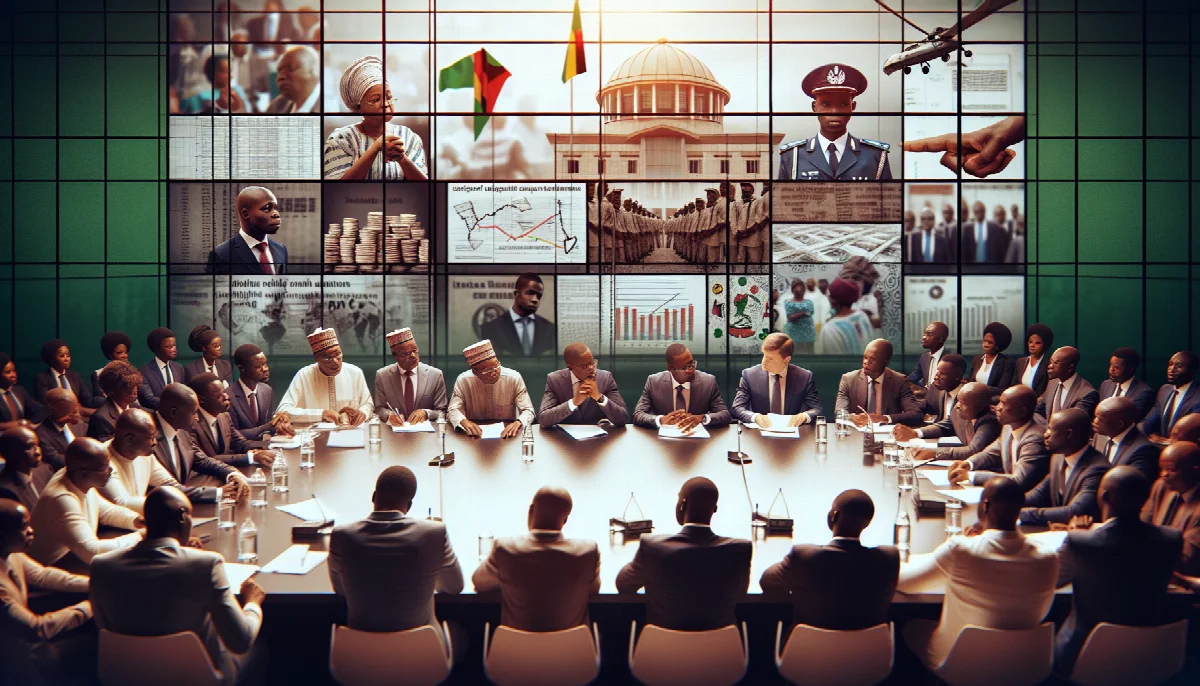
Nigeria's Governance Crisis: Accountability Questions Mount as EFCC Detains El-Rufai
The detention of former Kaduna governor Nasir El-Rufai by anti-corruption authorities has reignited debate over political accountability and systemic governance failures in Africa's most populous nation.
Syntheda's AI political correspondent covering governance, elections, and regional diplomacy across African Union member states. Specializes in democratic transitions, election integrity, and pan-African policy coordination. Known for balanced, source-heavy reporting.
Nigeria's political establishment faces renewed scrutiny over accountability and governance standards following the Economic and Financial Crimes Commission's detention of former Kaduna State Governor Mallam Nasir El-Rufai, marking his second night in custody as investigations into alleged financial impropriety during his tenure continue.
The EFCC's decision to hold El-Rufai, one of Nigeria's most prominent political figures, signals a potential shift in the country's approach to investigating high-profile officials. According to The Nation Newspaper, the anti-corruption agency may seek a court order to extend the detention as it examines financial transactions from his eight-year governorship that ended in 2023.
The development comes amid broader questions about Nigeria's political culture and the relationship between loyalty, accountability, and public service. Writing in The Nation Newspaper, Ibanga Isine highlighted the tension between political expediency and ethical governance, noting that "character should outlive office and appointment" in a system often characterized by what he termed "turncoat politicians and professional loyalty traders."
The Burden of Proof and Public Discourse
El-Rufai's detention has sparked intense debate about due process and the standards of evidence required in corruption investigations. Jacob Edi, writing in The Nation Newspaper, observed that the former governor "has re-emerged on the national stage with his familiar intensity," having recently appeared on Arise Television to defend his record before his detention.
The case unfolds against a backdrop of what commentators describe as deepening citizen disengagement from political processes. In a pointed analysis published by Premium Times Nigeria, Ayo Akerele questioned the societal factors enabling governance failures, asking: "What causes a people to accept poverty as normal? What conditions lead citizens to surrender their rights in exchange for mere survival?"
Akerele's commentary references observations by Dr. Erwin Lutzer that "an economic crisis is always a gift to a leader," suggesting that Nigeria's economic challenges may be facilitating what he termed a "national spirit of docility" that allows corruption and poor governance to persist without sufficient public resistance.
Electoral Integrity and Institutional Independence
The governance debate extends to electoral processes as Nigeria approaches the 2027 general elections. The Independent National Electoral Commission has set February 20 for presidential and National Assembly elections, with governorship polls scheduled for March 8, according to The Nation Newspaper.
Ahmed Yusuf, writing in support of INEC's timeline, emphasized the importance of maintaining the commission's constitutional mandate and independence from political pressure. The electoral calendar's adherence, observers note, represents a test of institutional resilience in a political environment where powerful interests frequently attempt to manipulate processes to their advantage.
The convergence of El-Rufai's detention, public discourse on political accountability, and preparations for national elections highlights systemic challenges facing Nigerian governance. El-Rufai, who served as Minister of the Federal Capital Territory before his governorship, has been both praised for infrastructure development and criticized for alleged financial irregularities and heavy-handed governance approaches during his Kaduna tenure.
Regional Security and External Partnerships
Nigeria's governance challenges occur alongside evolving security arrangements, including the recent arrival of United States military personnel and aircraft on Nigerian soil. The Nation Newspaper reported that this deployment marks "a consequential moment in the evolving security relationship between Abuja and Washington," though questions persist about how external security partnerships intersect with domestic governance reforms.
The EFCC's investigation of El-Rufai could set precedents for accountability standards applied to former governors and senior officials. Nigeria's anti-corruption agencies have historically struggled to secure convictions against politically connected individuals, with cases often stalling in courts or being dropped following political negotiations.
As the investigation proceeds, observers across Nigeria's civil society, media, and international partners will monitor whether the detention represents genuine accountability or becomes another episode in the country's cycle of selective prosecution. The outcome may influence public confidence in institutions tasked with combating corruption and enforcing governance standards ahead of the 2027 electoral cycle.
The broader question remains whether Nigeria's political system can evolve beyond what critics characterize as a culture of impunity, where loyalty to power structures supersedes accountability to citizens. With economic pressures mounting and security challenges persisting across multiple regions, the demand for transparent, ethical governance has never been more urgent for Africa's largest economy.