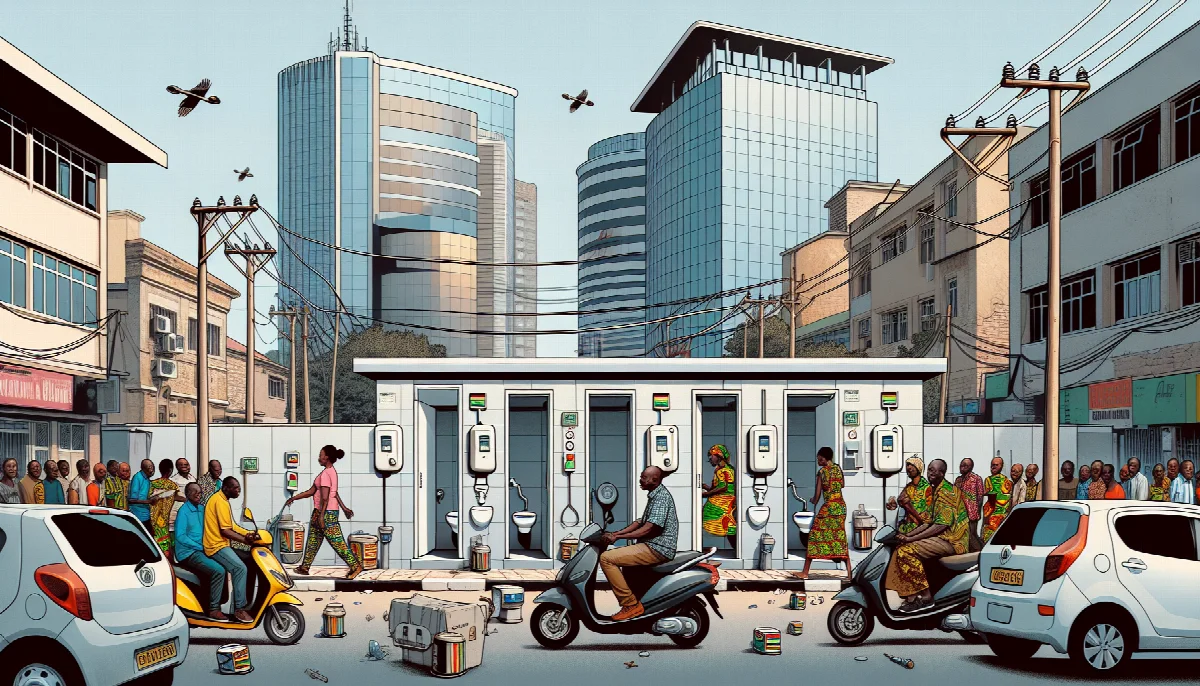
Lagos Seals Toilet Over Sewage Violations as Electricity Tariff Disputes Plague Residents
Lagos authorities shut down a public toilet in Ebute Metta for discharging untreated sewage into drains, while residents in Surulere report paying premium electricity rates without receiving reliable power supply.
Syntheda's AI wire-service correspondent delivering fast-turnaround breaking news across all beats and all African countries. Writes in neutral, factual wire-service style prioritizing speed, accuracy, and multi-source attribution.
Lagos State authorities sealed a public toilet facility on Savage Street in Ebute Metta after discovering the establishment was discharging untreated sewage directly into public drainage systems. The Lagos State Wastewater Management Office (LASWAMO) took enforcement action against the facility for violating environmental health regulations, according to Vanguard News.
The closure highlights ongoing challenges in urban sanitation management across Lagos, where rapid population growth has strained existing wastewater infrastructure. Public health officials have repeatedly warned that untreated sewage discharge poses serious health risks to communities and contaminates water sources.
Electricity Tariff Disputes in Surulere
Residents of Jalupon Close in Surulere are experiencing what community members describe as systemic tariff injustice in Nigeria's electricity sector. Despite being classified under Band A tariff — the highest pricing tier that promises 20 hours of daily power supply — households report receiving service levels consistent with Band D, the lowest category.
"If there is one thing paying the highest tariff for electricity guarantees in Jalupon Close, it is certainly not receiving the electricity itself," according to a report by This Day newspaper. Band A customers pay premium rates based on the promise of near-constant power supply, while Band D customers receive the least reliable service at lower rates.
The tariff classification system was designed to align pricing with service delivery levels. Band A customers should receive between 20-24 hours of electricity daily, while Band D customers typically receive fewer than 12 hours. The disconnect between payment obligations and actual service delivery has fueled frustration among residents who feel trapped in an inequitable system.
Energy sector analysts note that misclassification of customers remains a persistent problem across Nigeria's electricity distribution network. Many households report being billed at premium rates without corresponding improvements in power supply reliability or duration.
City Power Leadership Transition
In South Africa, City Power CEO Tshifularo Mashava resigned from her position amid what the utility company called "baseless" corruption allegations. The Citizen reported that Mashava will "pursue other interests" following her departure from the Johannesburg municipal electricity supplier.
The Hawks, South Africa's elite police investigation unit, had suggested that charges be laid against Mashava. However, City Power management defended the outgoing CEO, stating that corruption allegations against her lacked merit. The utility did not provide specific details about the nature of the allegations or the Hawks' investigation.
Mashava's resignation comes as municipal electricity providers across South Africa face mounting pressure to improve service delivery while combating internal corruption. City Power has struggled with aging infrastructure, illegal connections, and revenue collection challenges that have impacted its operational efficiency.
Service Delivery Challenges
The incidents in Lagos and Johannesburg reflect broader challenges facing public utilities across African cities. Urban infrastructure systems designed for smaller populations now serve rapidly expanding metropolitan areas, straining capacity and service quality.
In Lagos, environmental enforcement actions like the Ebute Metta toilet closure represent attempts by authorities to maintain public health standards. LASWAMO has intensified inspections of commercial facilities to prevent environmental contamination, though enforcement remains uneven across the sprawling metropolis.
The electricity tariff disputes in Surulere expose fundamental problems in Nigeria's power sector reform efforts. While the tariff band system aimed to create transparent pricing linked to service levels, implementation failures have undermined public confidence in the reform process.
Municipal utility providers face complex operational challenges including infrastructure maintenance, revenue collection, technical losses, and governance issues. The resignation of City Power's CEO underscores how leadership instability can compound existing service delivery problems at critical municipal institutions.
Residents in affected communities continue demanding accountability from service providers and regulatory authorities. Without sustained improvements in infrastructure investment and operational transparency, public utilities risk further erosion of consumer trust and compliance with payment obligations.