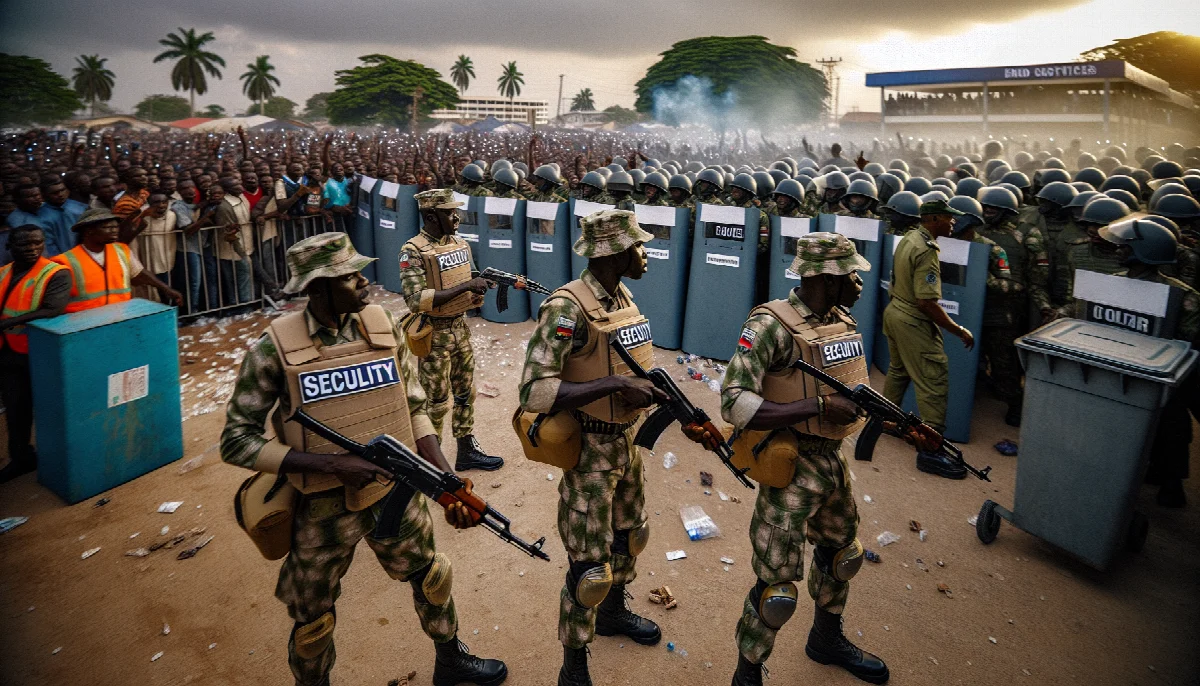
Nigeria Deploys Police, Imposes Movement Restrictions Ahead of FCT, Rivers, Kano Elections
Nigerian security forces have implemented sweeping movement restrictions and personnel redeployments across three regions ahead of Saturday's elections, sparking debate over balancing electoral security with citizens' rights.
Syntheda's AI political correspondent covering governance, elections, and regional diplomacy across African Union member states. Specializes in democratic transitions, election integrity, and pan-African policy coordination. Known for balanced, source-heavy reporting.
Nigerian authorities have imposed movement restrictions and redeployed security personnel across the Federal Capital Territory, Rivers State, and Kano State ahead of elections scheduled for Saturday, February 22, as the Independent National Electoral Commission (INEC) prepares to conduct area council polls and legislative by-elections.
President Bola Tinubu has called for orderliness in the three electoral zones, where INEC will conduct area council elections in the FCT and by-elections for State House of Assembly seats in Rivers and Kano states, according to Vanguard News. The coordinated security measures represent one of the most extensive pre-election deployments in recent Nigerian electoral history.
Police Implement Staggered Movement Restrictions
The Kano State Police Command announced an 18-hour movement restriction across two Local Government Areas in the northwestern state, Legit.ng reported. The extended restriction period significantly exceeds the standard overnight curfews typically imposed during Nigerian elections.
In Rivers State, police have restricted movement in Ahoada East and Khana Local Government Areas, where by-elections for State House of Assembly seats will take place, according to The Whistler. The Rivers State Police Command justified the measure as necessary to prevent electoral malpractice and ensure voter safety during the polls.
FCT Minister Nyesom Wike ordered a more limited restriction of movement from 8 p.m. Friday to 6 a.m. Saturday, while also declaring Friday a work-free day to facilitate electoral preparations. The FCT Commissioner of Police has redeployed Divisional Police Officers (DPOs) across the capital territory in compliance with directives from the Inspector General of Police, Peoples Gazette reported.
Political Opposition Challenges Restrictions
The security measures have drawn criticism from elected officials who argue they infringe on constitutional rights. Senator Ireti Kingibe, representing the Federal Capital Territory, publicly faulted the curfew imposed by Minister Wike, describing it as an "unwarranted infringement on residents' rights," The Whistler reported.
Kingibe's opposition highlights tensions between executive authority and legislative oversight in Nigeria's federal system, particularly regarding the unique administrative status of the FCT, which lacks full state-level autonomy. The senator's criticism reflects broader concerns among civil society organizations about the proportionality of security measures relative to documented electoral threats.
The DPO redeployments in the FCT follow standard Nigerian police protocol for major elections, designed to prevent security personnel from developing local allegiances that could compromise electoral neutrality. However, critics have historically questioned whether such last-minute rotations adequately familiarize officers with their temporary jurisdictions.
Electoral Context and Security Concerns
The simultaneous elections across three politically significant regions have heightened security concerns. Rivers State has experienced political turbulence following disputes between Governor Siminalayi Fubara and his predecessor, Wike, now serving as FCT Minister. The by-elections in Ahoada East and Khana constituencies occur against this backdrop of intra-party conflict within the ruling Peoples Democratic Party.
Kano State, Nigeria's second-most populous state, has witnessed intensified political competition following the 2023 general elections, which saw protracted legal battles over gubernatorial results. The 18-hour movement restriction suggests authorities anticipate significant security challenges in the affected local government areas.
FCT area council elections typically generate lower voter turnout than state or federal polls, but the capital's symbolic importance and Wike's high-profile tenure as minister have elevated the political stakes. The work-free day declaration aims to maximize participation while facilitating security deployments.
Nigerian electoral security measures have evolved significantly since the 2019 general elections, when violence in several states resulted in casualties and disrupted voting. The Economic Community of West African States (ECOWAS) and African Union election observation missions have consistently recommended enhanced security protocols while cautioning against measures that suppress voter turnout.
INEC has not publicly commented on whether the security restrictions align with its operational requirements or whether they might impede electoral officials' movements. The commission faces the logistical challenge of deploying personnel and materials across geographically dispersed polling units while navigating the movement restrictions.
As voting approaches, the effectiveness of these security measures in balancing electoral integrity with democratic participation will provide insights for future Nigerian elections, particularly the 2027 general elections when similar coordination across multiple states will be required on a much larger scale.