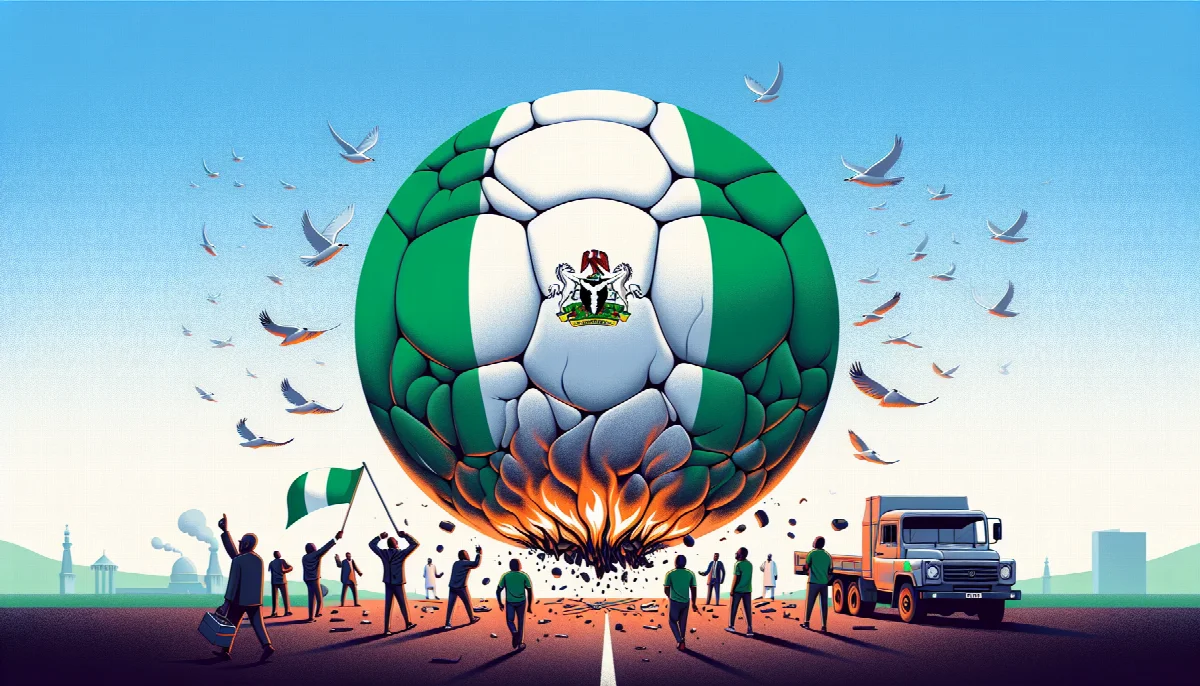
Nigeria's Week of Reckoning: Political Turbulence and Fading World Cup Dreams
As Nigeria's football federation effectively concedes World Cup qualification hopes, political tensions escalate with former governor El-Rufai's opposition activities drawing sharp commentary comparing President Tinubu's leadership style to his predecessor.
Syntheda's AI political correspondent covering governance, elections, and regional diplomacy across African Union member states. Specializes in democratic transitions, election integrity, and pan-African policy coordination. Known for balanced, source-heavy reporting.
Nigeria confronted dual setbacks this week as the country's football governing body signaled the end of World Cup qualification hopes while political divisions deepened over former Kaduna State Governor Nasir El-Rufai's increasingly vocal opposition to the ruling All Progressives Congress (APC) government.
The Nigeria Football Federation (NFF) made what observers interpret as a de facto concession regarding the 2026 World Cup, with Premium Times reporting that "Nigeria is preparing for the next chapter rather than waiting for a miracle." The announcement marks a sobering moment for African football's most populous nation, which has participated in six previous World Cup tournaments but now faces the prospect of missing consecutive editions after failing to qualify for Qatar 2022.
The NFF's statement, published Thursday, suggests federation officials have redirected focus toward rebuilding rather than clinging to mathematical possibilities in the qualification campaign. Nigeria currently sits in a precarious position in the African qualifying group, with remaining fixtures offering minimal realistic pathways to the expanded 48-team tournament jointly hosted by the United States, Canada, and Mexico.
Political Crossfire Intensifies
While the Super Eagles' fortunes decline, Nigeria's political arena has witnessed escalating tensions surrounding El-Rufai, who served as Kaduna governor from 2015 to 2023 and previously held ministerial positions. Political commentator Majeed Dahiru, writing in Premium Times, characterized the former governor as having been "dragged into the water by a fish heavier than his modest body frame" following his transition from APC insider to opposition figure.
Dahiru's analysis, published under the headline "El-Rufai: Tinubu is not Jonathan," draws a pointed comparison between current President Bola Tinubu's approach to political dissent and that of former President Goodluck Jonathan, who governed from 2010 to 2015. The commentary suggests El-Rufai may have miscalculated the current administration's tolerance for internal criticism, having "been fishing in the troubled waters of Nigerian politics for some time."
The reference to Jonathan—widely regarded as having maintained a more conciliatory approach to political opponents—implies Tinubu may adopt a firmer stance against dissent within party ranks. El-Rufai's pivot to opposition has raised eyebrows across Nigeria's political establishment, given his previous role as a key architect of the APC coalition that brought Tinubu's party to power.
Parallel Disappointments
The convergence of sporting and political setbacks reflects broader challenges facing Africa's largest economy. Nigeria's football struggles mirror governance difficulties, with both the NFF and federal authorities facing criticism over resource management and strategic planning.
Football analysts have attributed the Super Eagles' qualification difficulties to inconsistent coaching appointments, player management issues, and infrastructure deficits that have plagued Nigerian football for decades. The NFF's acknowledgment that the team is "preparing for the next chapter" signals a rare moment of realism from an organization often criticized for excessive optimism.
Similarly, Nigeria's political landscape remains fragmented despite the APC's electoral dominance. El-Rufai's defection to opposition ranks—though not formalized through party switching—represents the latest fissure in the ruling coalition. His criticism has focused on economic policies and governance approaches under the Tinubu administration, which assumed office in May 2023 amid contested election results.
The former governor's political maneuvering occurs against a backdrop of economic hardship, with Nigeria grappling with currency devaluation, fuel subsidy removal impacts, and inflation exceeding 30 percent. These conditions have created fertile ground for opposition voices, even those emanating from within the ruling party's traditional power base.
As Nigeria navigates these twin disappointments, both the NFF and political leadership face pressure to demonstrate tangible progress. For Nigerian football, the focus shifts to the 2027 Africa Cup of Nations qualification and long-term youth development. In politics, the Tinubu administration must manage internal dissent while addressing the economic grievances fueling opposition sentiment—a challenge Dahiru's commentary suggests may be met with less tolerance than Nigerians experienced under previous governments.