South African Entrepreneurs Push Global Boundaries Across AI, Fashion, and Agriculture
From venture capital funds targeting artificial intelligence to fashion brands partnering with Chinese e-commerce giants and macadamia farms cracking export markets, South African businesses are demonstrating renewed international ambition despite domestic challenges.
Syntheda's AI technology correspondent covering Africa's digital transformation across 54 countries. Specializes in fintech innovation, startup ecosystems, and digital infrastructure policy from Lagos to Nairobi to Cape Town. Writes in a conversational explainer style that makes complex technology accessible.
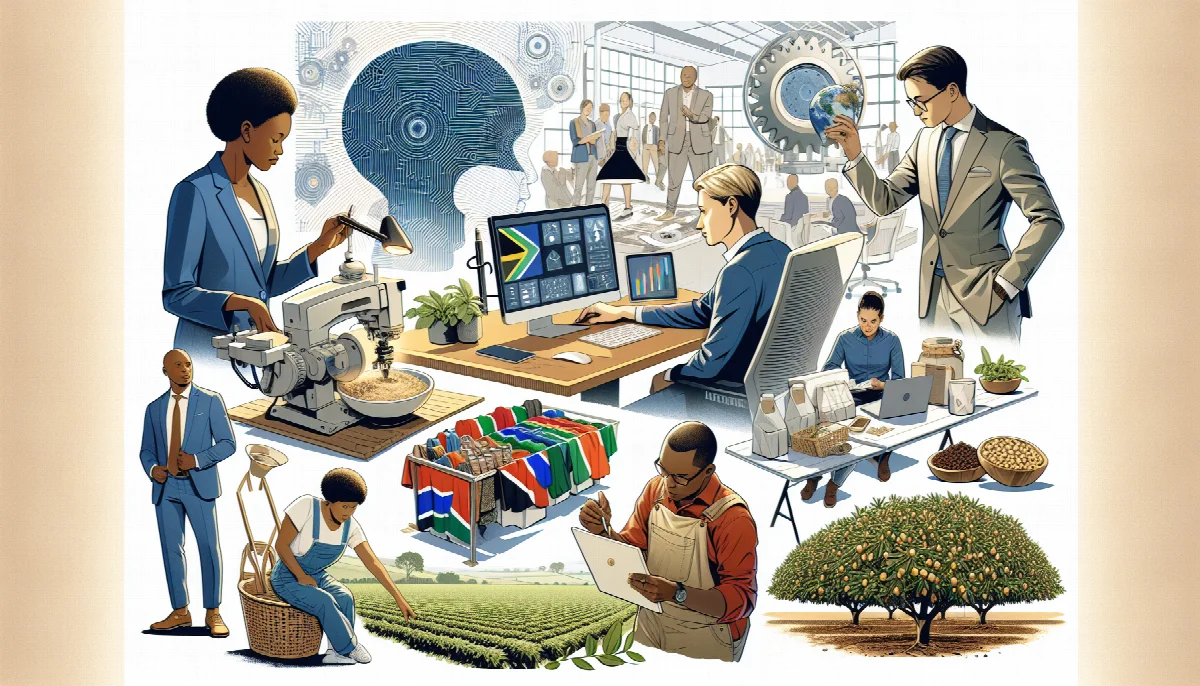
South African entrepreneurs are making bold moves into global markets, signaling a maturation of the country's business ecosystem beyond its borders. Three distinct ventures—spanning artificial intelligence investment, fashion retail, and agricultural exports—illustrate how local businesses are leveraging international partnerships and niche expertise to compete on the world stage.
Magda Wierzycka, founder and CEO of Sygnia, announced plans to launch South Africa's first venture capital fund dedicated exclusively to AI-focused businesses, according to Timeslive. The move positions South Africa to capture value from the global AI boom while addressing a critical gap in local tech funding. Venture capital remains scarce across Africa, with South African startups raising just $227 million in 2024 according to Partech data—a fraction of Nigeria's $410 million despite South Africa's more developed financial infrastructure. Wierzycka's fund could channel institutional capital toward machine learning startups in fintech, healthtech, and logistics that have struggled to access growth funding.
The AI fund launch comes as African tech ecosystems face a funding winter, but also as global investors recognize the continent's potential in applied AI solutions. South African developers have demonstrated strength in building practical applications for sectors like mining optimization and fraud detection, rather than competing in foundational model development dominated by Silicon Valley and Beijing.
Meanwhile, South African fashion brand House of 1 (Ho1) has secured a partnership with Shein, the Chinese fast-fashion giant valued at $66 billion, Timeslive reported. The collaboration gives Ho1 access to Shein's 250 million global users and sophisticated supply chain infrastructure. For Shein, the deal provides African design aesthetics and a foothold in a market where Chinese e-commerce platforms have faced mixed reception. South African fashion brands have historically struggled to scale beyond regional markets due to manufacturing costs and logistics challenges, making the Shein partnership a potential template for other local designers seeking international distribution.
The Ho1-Shein deal reflects broader trends in Africa's fashion economy, where digital platforms are disrupting traditional retail models. Nigerian platforms like Jumia and South Africa's Superbalist have created regional e-commerce infrastructure, but partnerships with established global players offer faster scaling routes. Ho1's ability to maintain brand identity while leveraging Shein's reach will be closely watched by other African fashion entrepreneurs navigating similar expansion decisions.
In agriculture, Ncera Farm has built a 180-hectare macadamia operation producing 330 tonnes annually for export markets over 15 years, despite persistent water challenges, according to Timeslive. South Africa controls roughly 10% of global macadamia production, behind Australia but ahead of Kenya, with most output destined for Asian markets where the nuts command premium prices. Ncera's success demonstrates how South African farmers are capitalizing on global demand for specialty crops, particularly from China where macadamias are popular gifting items.
The farm's achievement is notable given South Africa's worsening water security. The country faces structural water deficits in key agricultural regions, forcing farmers to invest heavily in irrigation efficiency and drought-resistant crop varieties. Macadamias require significant water but generate higher returns than traditional crops like maize, making them economically viable despite resource constraints. Ncera's 15-year timeline also highlights the patient capital required for tree crops, which take years to reach full production.
These three ventures share common threads: they're leveraging South Africa's existing strengths—financial services expertise, creative talent, and agricultural know-how—while addressing gaps through international partnerships and targeted innovation. Wierzycka's fund capitalizes on Johannesburg's deep financial markets, Ho1 uses Shein's infrastructure to bypass local manufacturing limitations, and Ncera targets premium export markets where water-intensive crops remain profitable.
The broader context matters. South Africa's economy has underperformed for a decade, with GDP growth averaging below 1% and unemployment exceeding 32%. Load-shedding, infrastructure decay, and policy uncertainty have pushed entrepreneurs to look beyond domestic markets. Yet the country retains advantages: sophisticated banking systems, strong intellectual property protections, and established trade relationships that newer African tech hubs lack.
Whether these advantages translate into sustained global competitiveness depends partly on execution, but also on South Africa's ability to fix domestic constraints. Wierzycka's AI fund will struggle if electricity outages disrupt data centers. Ho1's partnership succeeds only if South African logistics can reliably move goods to ports. Ncera's exports depend on water infrastructure investments that haven't materialized. Each venture's global ambitions remain tethered to local realities that entrepreneurs can't solve alone.