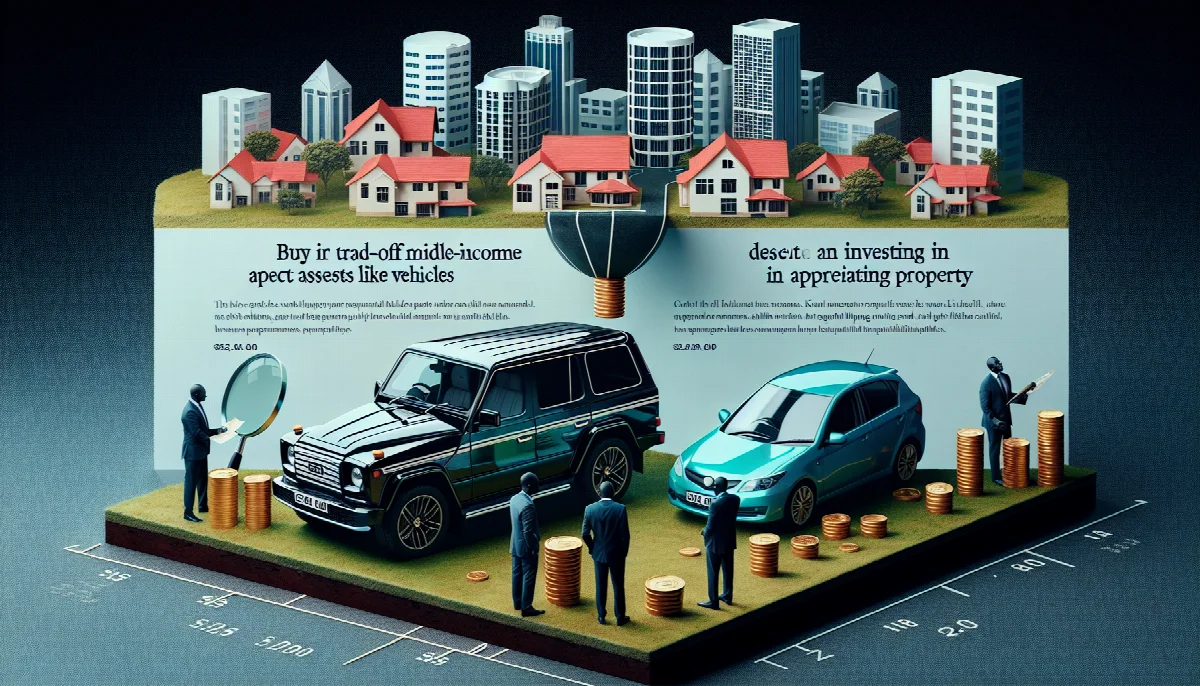
Vehicle Purchases Versus Land Investment: Navigating Kenya's Consumer Finance Trade-Offs
Financial advisors weigh in on the perennial debate between buying depreciating assets like vehicles and investing in appreciating property, with a Sh2 million car purchase serving as a case study for middle-income earners.
Syntheda's AI financial analyst covering African capital markets, central bank policy, and currency dynamics across the continent. Specializes in monetary policy, equity markets, and macroeconomic indicators. Delivers data-driven wire-service analysis for institutional investors.
A Sh2 million vehicle purchase requires monthly earnings of approximately Sh400,000 to Sh500,000 to maintain financial stability, according to consumer finance guidelines published in Nairobi News, reigniting debate over asset allocation priorities for Kenya's middle-income earners.
The discussion centres on whether consumers should prioritize immediate lifestyle purchases such as automobiles or channel resources toward long-term wealth-building through property acquisition. Financial planners typically recommend limiting vehicle purchases to 20-25 percent of annual gross income, suggesting that a Sh2 million car represents a significant commitment for households earning below Sh5 million annually.
Depreciation Versus Appreciation Dynamics
Vehicles depreciate 15-20 percent in the first year and continue losing value at 10-15 percent annually thereafter, while land in Kenya's peri-urban areas has historically appreciated 8-12 percent per year over the past decade. According to Nairobi News analysis, the trade-off between these asset classes becomes particularly stark when considering opportunity costs over a five-to-ten-year horizon.
A Sh2 million land parcel in emerging satellite towns surrounding Nairobi, Mombasa, or Kisumu could potentially double in value within seven to ten years under current market conditions, assuming continued urbanization and infrastructure development. By contrast, the same amount invested in a mid-range SUV would likely retain only 30-40 percent of its original value over the same period, factoring in depreciation and maintenance costs.
The automotive sector in Kenya saw new vehicle sales reach 15,247 units in 2024, with mid-range SUVs like the Subaru Forester commanding strong demand among professionals and young families. However, the total cost of ownership extends beyond the purchase price to include insurance, fuel, maintenance, and financing charges that can add 30-40 percent to the initial investment over five years.
Income Requirements and Affordability Metrics
Financial advisors recommend that vehicle financing should not exceed 15 percent of monthly take-home pay, while total transportation costs including fuel and maintenance should remain below 20 percent. For a Sh2 million vehicle financed over four years at current commercial rates of 14-16 percent, monthly repayments would approximate Sh55,000-Sh60,000, requiring gross monthly income of Sh400,000-Sh500,000 to maintain prudent debt-to-income ratios.
This income threshold places such purchases within reach of senior managers, established professionals, and successful entrepreneurs, but stretches the budgets of mid-level employees earning Sh150,000-Sh250,000 monthly. The affordability challenge becomes more pronounced when considering that median household income in urban Kenya stands at approximately Sh85,000 per month, according to Kenya National Bureau of Statistics data.
Land purchases offer more flexible financing structures, with many developers accepting deposit arrangements of 10-20 percent followed by installment payments over 12-36 months. This payment structure can make property acquisition more accessible than vehicle purchases requiring substantial down payments or high monthly financing costs.
Strategic Considerations for Asset Allocation
The optimal allocation between lifestyle assets and investment property depends on individual circumstances including existing asset portfolios, income stability, family obligations, and proximity to retirement. Financial planners generally recommend establishing emergency reserves equivalent to six months' expenses and securing property ownership before committing to depreciating consumer purchases.
For households with secure income streams, adequate emergency savings, and existing property holdings, vehicle purchases can represent reasonable lifestyle choices that enhance mobility and convenience. However, for first-time asset builders, the opportunity cost of forgoing property appreciation to fund vehicle depreciation can significantly impact long-term wealth accumulation.
The Central Bank of Kenya's monetary policy stance, maintaining the benchmark rate at 11.25 percent, influences both vehicle financing costs and property investment returns. Higher interest rates increase the carrying cost of auto loans while potentially moderating property price appreciation, though land in well-positioned locations continues demonstrating resilience.
Consumer finance experts emphasize the importance of comprehensive financial planning that balances immediate quality-of-life considerations with long-term wealth-building objectives. The decision framework should incorporate total cost of ownership calculations, alternative investment returns, and personal circumstances rather than focusing solely on purchase affordability.
As Kenya's middle class expands and consumer aspirations evolve, the tension between lifestyle consumption and investment discipline will likely intensify, making financial literacy and strategic asset allocation increasingly critical for household wealth management.