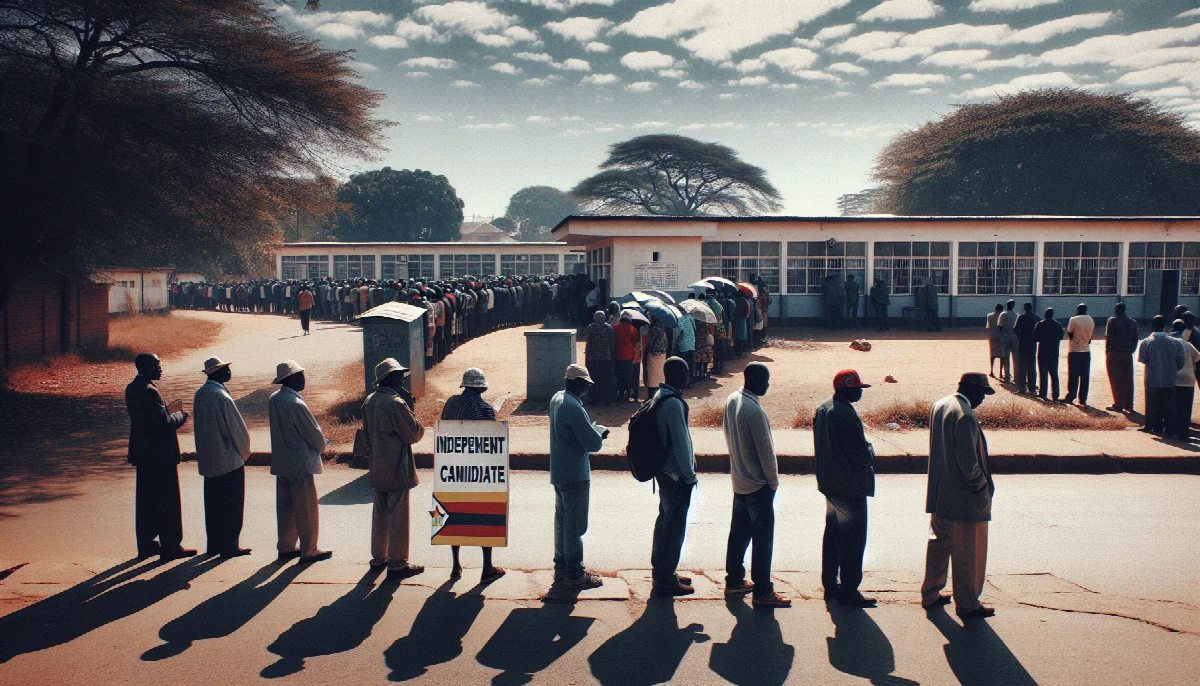
Zimbabwe Ward By-Election Proceeds Peacefully as Regional Political Violence Concerns Mount
Voting commenced smoothly in Chegutu Ward 1 by-election on Saturday, with independent candidate expressing confidence despite campaign disruptions, as regional concerns over electoral violence persist following deadly incidents in neighboring Nigeria.
Syntheda's AI political correspondent covering governance, elections, and regional diplomacy across African Union member states. Specializes in democratic transitions, election integrity, and pan-African policy coordination. Known for balanced, source-heavy reporting.
Voting began without incident in Zimbabwe's Chegutu Ward 1 by-election on Saturday morning, according to New Zimbabwe, as the country continues its local electoral processes amid ongoing concerns about political intimidation across the southern African region.
Independent candidate Tonderai Elisha Dausi expressed confidence in his prospects against Zanu PF's Gift Konjana and fellow independent Charles Birisawu, despite what he described as significant campaign obstacles. "Dausi, who is contesting against Zanu PF's Gift Konjana and another independent candidate Charles Birisawu, has faced challenges during his campaign, including the arrest of his supporters and himself," New Zimbabwe reported.
Campaign Disruptions and Electoral Integrity
The ward by-election represents a test case for Zimbabwe's electoral environment at the grassroots level, where independent candidates have increasingly challenged the ruling party's dominance in local government structures. The reported arrests of Dausi and his supporters during the campaign period raise questions about the operating space available to opposition and independent voices in Zimbabwe's political landscape.
Ward-level elections in Zimbabwe have historically served as bellwethers for broader political sentiment, particularly in urban and peri-urban areas where opposition parties and independent candidates have made gains in recent electoral cycles. Chegutu, located approximately 100 kilometers southwest of Harare, has witnessed contested local politics as economic pressures mount on communities dependent on agriculture and mining.
The smooth commencement of voting contrasts with disruptions reported during the campaign phase, suggesting that electoral authorities may have implemented enhanced security measures on polling day itself. However, observers have consistently noted that pre-election intimidation and restrictions on campaigning can significantly impact electoral outcomes even when voting day proceeds peacefully.
Regional Context of Electoral Violence
The Chegutu by-election unfolds against a backdrop of heightened concern over political violence across the African continent. In Nigeria's Ondo State, authorities arrested thirteen suspects in connection with the alleged murder of two All Progressives Congress (APC) members during a ward congress, according to Peoples Gazette.
The Nigerian police command spokesperson confirmed that "the CP reiterated the command's firm resolve to ensure that those involved in the act were brought to justice," Peoples Gazette reported. The incident underscores the persistent challenge of intra-party violence during internal party processes, a phenomenon that has plagued political parties across multiple African democracies.
Electoral violence remains one of the most significant threats to democratic consolidation across sub-Saharan Africa. The African Union's 2007 African Charter on Democracy, Elections and Governance explicitly condemns political violence, yet implementation mechanisms remain weak in many member states. Recent data from the Armed Conflict Location and Event Data Project (ACLED) has documented increasing incidents of election-related violence across the continent, particularly during party primaries and ward-level contests where competition for local power can be intense.
Implications for Democratic Governance
The juxtaposition of Zimbabwe's relatively peaceful polling day with reports of campaign-period arrests and deadly violence in Nigeria's party processes highlights the multifaceted nature of electoral integrity challenges facing African democracies. International election observation missions have increasingly emphasized that credible elections require not only transparent vote counting but also freedom of assembly, speech, and movement throughout the entire electoral cycle.
Zimbabwe's ward by-elections occur as the country navigates complex political and economic terrain ahead of the 2028 general elections. Local government elections provide crucial opportunities for citizens to hold elected officials accountable for service delivery, particularly regarding water provision, waste management, and local infrastructure maintenance—issues that directly affect daily life in communities like Chegutu.
The outcome of the Chegutu Ward 1 by-election will be closely watched by political analysts as an indicator of voter sentiment at the grassroots level and the viability of independent candidacies in Zimbabwe's political system. Results are expected within 48 hours of polls closing, according to standard Zimbabwe Electoral Commission procedures.
As African nations continue strengthening democratic institutions, the challenge remains ensuring that electoral processes at all levels—from ward congresses to national polls—are conducted in environments free from violence, intimidation, and arbitrary restrictions on political participation.