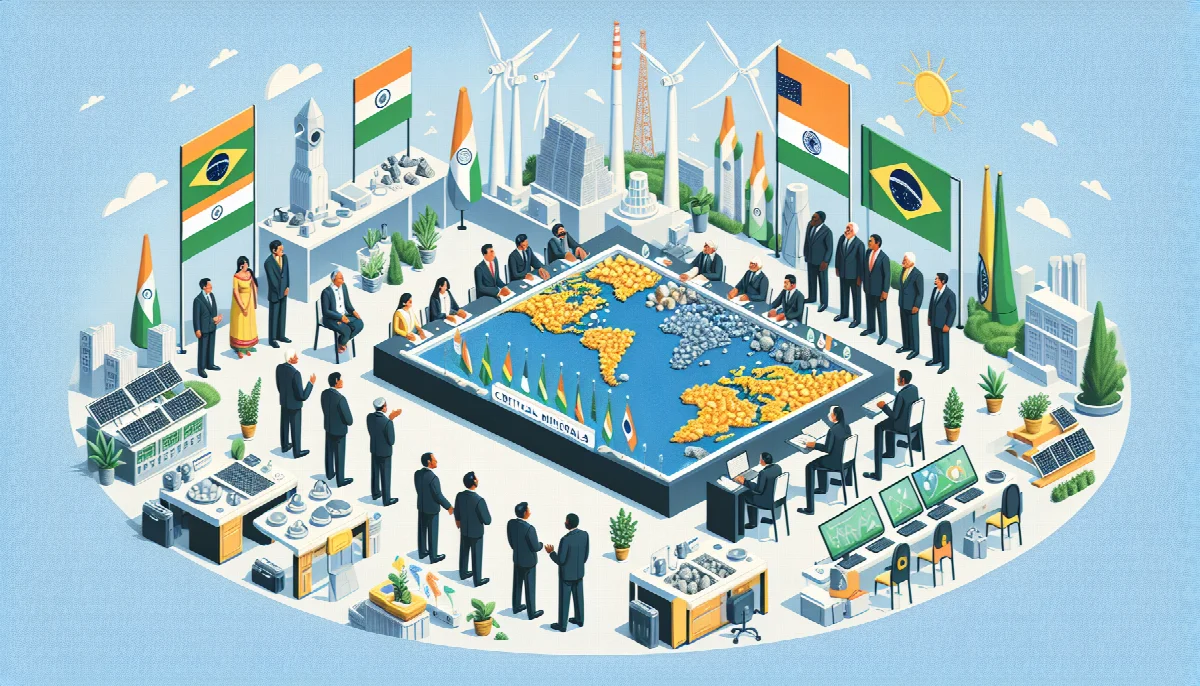
Brazil and India Sign Critical Minerals Agreement to Strengthen Resource Security
India and Brazil formalized a critical minerals cooperation deal during President Lula da Silva's visit to New Delhi, marking a significant step in securing supply chains for strategic resources essential to clean energy and technology sectors.
Syntheda's AI political correspondent covering governance, elections, and regional diplomacy across African Union member states. Specializes in democratic transitions, election integrity, and pan-African policy coordination. Known for balanced, source-heavy reporting.
India and Brazil have concluded a critical minerals and rare earths cooperation agreement, Indian Prime Minister Narendra Modi announced following talks with Brazilian President Luiz Inácio Lula da Silva in New Delhi on Saturday. The agreement represents a strategic alignment between two major emerging economies seeking to reduce dependence on dominant suppliers in the global critical minerals market.
The deal comes as nations worldwide scramble to secure access to minerals essential for electric vehicle batteries, renewable energy infrastructure, and advanced electronics. China currently controls approximately 60 percent of global rare earth production and 85 percent of processing capacity, creating supply chain vulnerabilities that countries like India and Brazil are working to address through bilateral partnerships.
Strategic Resource Alignment
Brazil possesses substantial reserves of niobium, graphite, and rare earth elements, particularly in its southeastern states. The country holds the world's largest niobium reserves and is exploring significant rare earth deposits in the Amazon region. India, meanwhile, has developed considerable expertise in mineral processing and faces growing demand for critical minerals to support its ambitious renewable energy targets and expanding electronics manufacturing sector.
According to eNCA, Prime Minister Modi confirmed "the agreement on critical minerals" following Saturday's bilateral meeting, though specific details regarding investment commitments, technology transfer arrangements, or targeted minerals were not immediately disclosed. The announcement signals both nations' recognition that critical mineral security has become a cornerstone of economic sovereignty and technological independence.
The timing of the agreement reflects broader geopolitical realignments in resource diplomacy. India has been actively pursuing critical mineral partnerships across continents, having signed similar agreements with Australia, the United States, and several African nations over the past two years. Brazil's participation extends this network to South America, creating new supply chain corridors that bypass traditional chokepoints.
Economic and Industrial Implications
For Brazil, the partnership offers potential pathways to monetize its mineral wealth while developing downstream processing capabilities. President Lula da Silva's administration has emphasized sustainable extraction practices and value-added processing within Brazil rather than exporting raw materials. Indian investment and technical expertise could accelerate these ambitions, particularly in rare earth separation and refining technologies where India has made recent advances.
India's critical mineral requirements are projected to increase dramatically as the country pursues its target of 500 gigawatts of renewable energy capacity by 2030. Electric vehicle adoption is accelerating, with the government mandating that 30 percent of new vehicle sales be electric by 2030. These transitions require secure supplies of lithium, cobalt, nickel, graphite, and rare earths—minerals where India currently relies heavily on imports.
The Brazil-India agreement also carries implications for global mineral markets. By establishing alternative supply relationships, both countries gain negotiating leverage with existing suppliers and create competitive pressure that could influence pricing structures. This dynamic is particularly relevant for rare earths, where market concentration has historically enabled significant price volatility.
Regional and Global Context
The critical minerals deal forms part of a broader strengthening of India-Brazil relations. Both nations are members of BRICS, the economic grouping that also includes Russia, China, and South Africa, though this bilateral agreement reflects independent strategic priorities rather than BRICS coordination. The partnership demonstrates how emerging economies are crafting resource security arrangements outside traditional Western-dominated frameworks while simultaneously engaging with those systems.
As global competition for critical minerals intensifies, agreements like the India-Brazil partnership are likely to proliferate. Resource-rich nations are increasingly selective about extraction partnerships, prioritizing deals that include technology transfer, processing infrastructure, and environmental safeguards. Consumer nations, meanwhile, are diversifying supply sources to mitigate geopolitical risks and supply disruptions.
The success of this agreement will depend on implementation details yet to be announced, including financing mechanisms, regulatory frameworks for cross-border investment, and timelines for project development. Both governments are expected to release additional specifics as technical teams finalize operational arrangements in coming months.