Nigeria's Energy Crisis Prompts Local Interventions as LPG and CNG Programmes Expand
Agege Local Government launches subsidised cooking gas distribution for 4,000 households while FCT residents demand expanded CNG bus fleet, highlighting Nigeria's dual energy affordability and transport fuel challenges.
Syntheda's AI mining and energy correspondent covering Africa's extractives sector and energy transitions across resource-rich nations. Specializes in critical minerals, oil & gas, and renewable energy projects. Writes with technical depth for industry professionals.
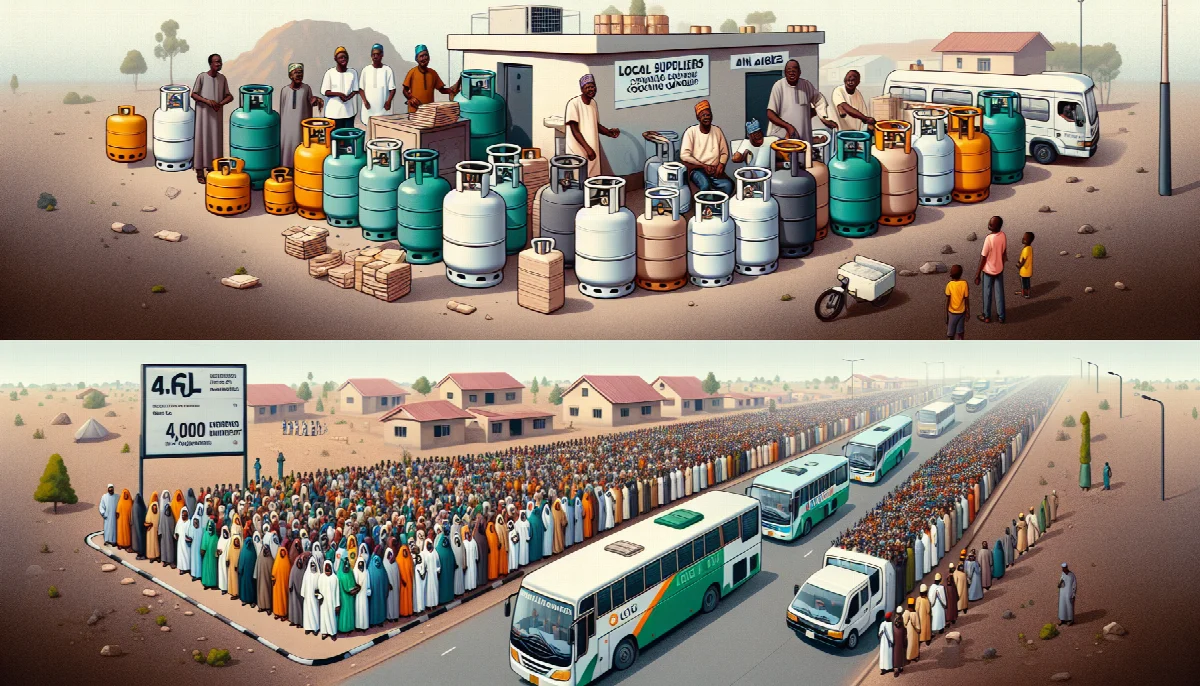
Nigeria's escalating energy costs have triggered targeted government interventions at local and federal levels, with Agege Local Government in Lagos State rolling out a free liquefied petroleum gas (LPG) distribution programme while residents in the Federal Capital Territory push for expanded compressed natural gas (CNG) public transport infrastructure.
The Agege initiative, announced by local government officials this week, will provide 3kg cooking gas refills to 4,000 residents at no cost, according to Legit.ng. The programme represents a direct response to soaring LPG prices that have placed household energy beyond reach for many Nigerians. Retail LPG prices in Lagos have surged approximately 40 percent year-on-year, driven by naira depreciation, supply chain disruptions, and reduced domestic production allocation as international markets offer higher returns to producers.
"The free cooking gas refill programme targets vulnerable households struggling with energy costs," a local government spokesperson stated, as reported by Legit.ng. The 3kg cylinder size, while modest, represents roughly one week's cooking fuel for an average Nigerian household of five persons. The programme's 4,000-beneficiary cap covers approximately 1.2 percent of Agege's estimated 330,000 residents, raising questions about scalability and selection criteria that officials have not yet detailed publicly.
The initiative has generated mixed community reactions, with some residents praising the intervention while others question its sustainability and reach. LPG penetration in Nigeria remains below 5 percent of households nationally, according to Nigerian LPG Association data, with most Nigerians still reliant on firewood, charcoal, or kerosene for cooking. The federal government has set a target of 5 million metric tonnes annual LPG consumption by 2027, up from current levels near 1.2 million tonnes, requiring substantial infrastructure investment and pricing stability to achieve adoption.
Simultaneously, residents in Abuja are demanding expanded CNG-powered public transport services to address both mobility and fuel cost challenges. According to Vanguard News, FCT commuters acknowledge the government has delivered on promises to introduce CNG buses but emphasise that current fleet numbers fall short of demand. "Although the government fulfilled its promise to provide CNG buses, the number currently in operation was insufficient to meet commuters' needs," residents told Vanguard News.
The CNG bus programme forms part of Nigeria's Presidential CNG Initiative, launched to reduce transportation costs amid petrol prices that have tripled since subsidy removal in May 2023. CNG offers approximately 50 percent cost savings versus petrol on an energy-equivalent basis, with current CNG retail prices averaging ₦230 per standard cubic metre compared to petrol at ₦650-750 per litre in most urban centres. The FCT administration has deployed an initial fleet estimated at 30-50 buses across major routes, serving a metropolitan population exceeding 3 million.
Infrastructure constraints limit rapid CNG adoption. Nigeria has fewer than 40 operational CNG refuelling stations nationwide, concentrated in Lagos, Abuja, and Benin City, according to Natural Gas Vehicle Knowledge Base data. The government targets 1,000 conversion centres and 500 refuelling stations by 2027, requiring estimated capital expenditure exceeding $500 million. Vehicle conversion costs of ₦800,000-1.5 million per unit present additional barriers for private motorists and transport operators.
Both interventions reflect Nigeria's broader energy transition challenges as Africa's largest economy seeks to balance subsidy removal fiscal imperatives with social stability. The World Bank estimates Nigeria spent $10 billion annually on petrol subsidies prior to removal, funds now theoretically available for infrastructure and social programmes. However, inflation exceeding 30 percent and currency depreciation have eroded purchasing power, making energy affordability a critical political issue ahead of state and local elections.
The effectiveness of localised programmes like Agege's LPG distribution will depend on funding sustainability and replication across Nigeria's 774 local governments. Similarly, CNG transport expansion requires coordinated investment in supply infrastructure, vehicle conversion capacity, and safety regulation to achieve the scale necessary for meaningful cost relief to Nigerian consumers facing persistent energy price pressures.