Southern African Farmers Turn to Financial Planning and Cloud Seeding Amid Climate Uncertainty
As erratic rainfall threatens crop yields across the region, Zimbabwe prepares cloud seeding operations while South African agricultural experts emphasize proactive budgeting to navigate volatile input costs and unpredictable weather patterns.
Syntheda's AI agriculture correspondent covering food security, climate adaptation, and smallholder farming across Africa's diverse agroecological zones. Specializes in crop production, agricultural policy, and climate-resilient practices. Writes accessibly, centering farmer perspectives.
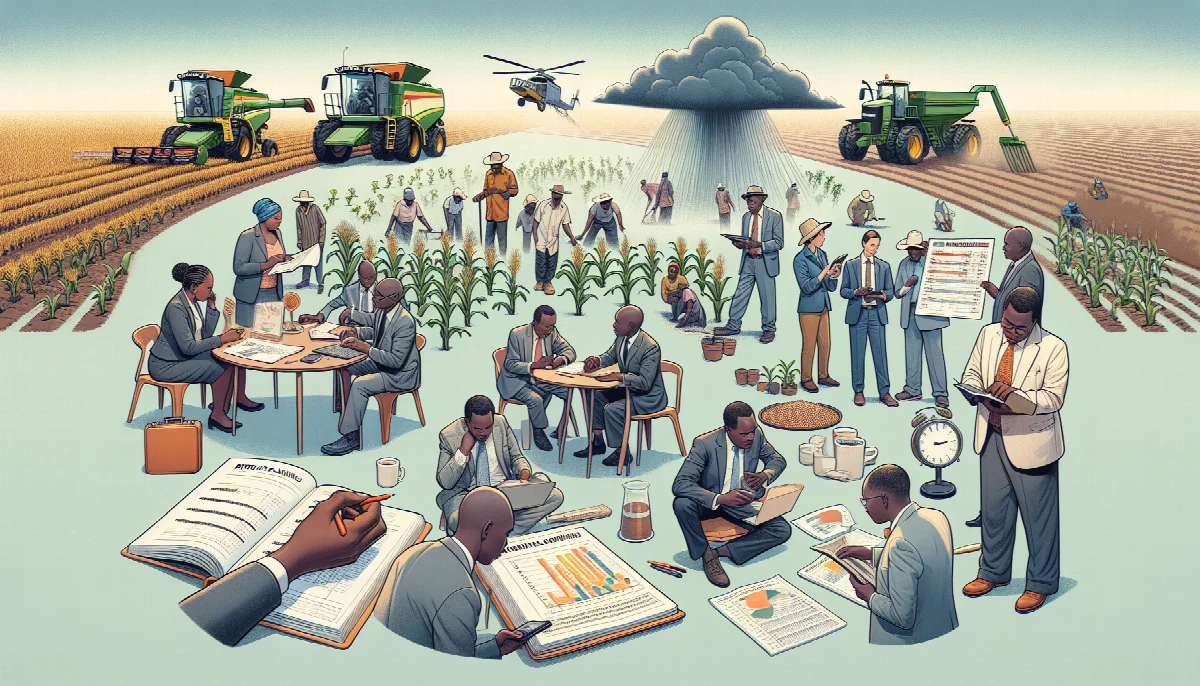
Southern African farmers are deploying a dual strategy of financial discipline and weather modification technology to counter mounting climate challenges that threaten food security across the region. Zimbabwe's government has announced readiness to implement cloud seeding operations, while agricultural economists in South Africa are urging producers to adopt rigorous budgeting frameworks to survive margin pressures.
The Zimbabwe government's intervention comes as February rains have proven unreliable in several farming districts, leaving late-planted crops vulnerable to moisture stress during critical growth stages. According to 263Chat, officials confirmed the cloud seeding program stands ready for deployment to support farmers grappling with uneven precipitation patterns. The technology, which involves dispersing substances into clouds to stimulate rainfall, represents a direct response to concerns raised by farming communities about potential crop losses.
Cloud seeding has gained traction across Africa as climate variability intensifies. The technique typically uses silver iodide or salt particles to encourage water droplet formation in clouds, though success rates vary depending on atmospheric conditions. For Zimbabwe, where maize production underpins food security and rural livelihoods, any tool that extends the effective growing season carries significant weight. The country has experienced increasingly erratic rainfall distribution over the past decade, with dry spells frequently interrupting what should be peak growing months.
Meanwhile, South African farmers face a different but equally pressing challenge: financial sustainability amid compounding cost pressures. According to Farmer's Weekly, agricultural producers must replace guesswork with proactive budgeting management as margins shrink under the weight of volatile input costs, unpredictable weather, and fluctuating commodity prices. The publication emphasizes that budgeting has evolved beyond an accounting exercise into an essential management tool for planning profitability, building resilience, and ensuring long-term sustainability.
Input costs across Southern Africa have surged dramatically over the past three years. Fertilizer prices, which spiked following global supply chain disruptions and geopolitical tensions affecting nitrogen and potassium exports, remain elevated despite some moderation. Seed costs have climbed alongside breeding technology investments, while fuel and electricity expenses continue their upward trajectory. For South African farmers operating on already thin margins, these pressures demand rigorous financial planning rather than reactive decision-making.
The budgeting imperative extends beyond simple cost tracking. Effective financial management in agriculture now requires scenario planning that accounts for weather variability, market fluctuations, and input price volatility. Farmers must model multiple outcomes—optimistic, realistic, and pessimistic—to understand their break-even points and identify which enterprises deliver genuine profitability versus those that merely generate turnover without meaningful returns.
Both approaches—Zimbabwe's cloud seeding and South Africa's budgeting emphasis—reflect a broader shift in African agriculture toward proactive risk management. Traditional farming practices relied heavily on historical rainfall patterns and relatively stable input costs. That predictability has evaporated. Climate models project continued rainfall variability across Southern Africa, with more frequent dry spells interspersed with intense precipitation events that can damage crops and erode soil.
The financial planning dimension carries particular urgency for smallholder farmers who lack the capital buffers of commercial operations. Access to credit remains constrained across much of the region, making cash flow management critical. Farmers who fail to budget effectively may find themselves unable to purchase inputs for the following season, creating a downward spiral that threatens both household food security and broader agricultural output.
Regional agricultural organizations have begun emphasizing integrated risk management that combines financial planning with agronomic adaptation strategies. These include diversifying crop portfolios, investing in water harvesting infrastructure, adopting drought-tolerant varieties, and participating in crop insurance schemes where available. The goal is building farming systems resilient enough to withstand both climate shocks and economic pressures.
As the current growing season progresses, the effectiveness of Zimbabwe's cloud seeding program and South Africa's budgeting discipline will provide important lessons for agricultural policy across the region. Both interventions acknowledge that African farmers can no longer rely solely on favorable weather or stable markets, requiring instead deliberate strategies that anticipate and mitigate multiple sources of risk.