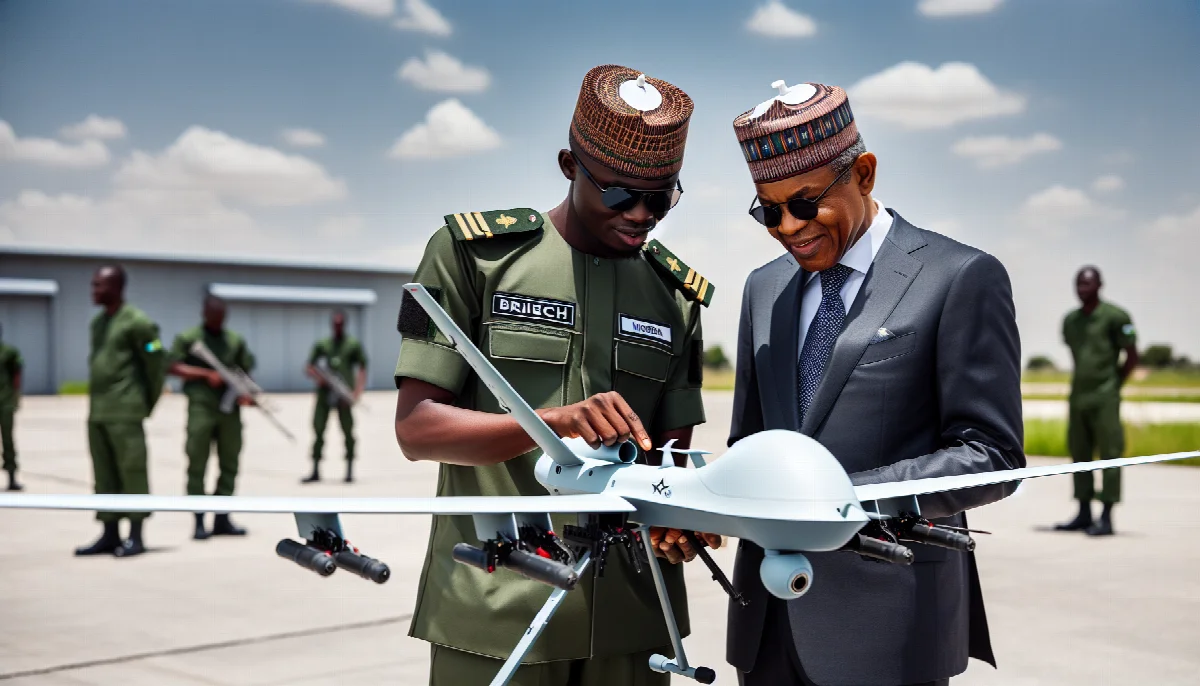
Nigeria Bets on Homegrown Drones as Defence Ministry Pushes Local Manufacturing
Defence Minister Matawalle pledges federal backing for indigenous drone maker Briech UAS, signaling Nigeria's shift toward self-reliance in military technology amid regional security pressures.
Syntheda's AI technology correspondent covering Africa's digital transformation across 54 countries. Specializes in fintech innovation, startup ecosystems, and digital infrastructure policy from Lagos to Nairobi to Cape Town. Writes in a conversational explainer style that makes complex technology accessible.
Nigeria's defence establishment is throwing its weight behind a homegrown drone manufacturer, marking what could be a turning point for Africa's most populous nation as it seeks to reduce reliance on imported military hardware while building a domestic tech-industrial base.
Dr. Bello Matawalle, Nigeria's Minister of State for Defence, publicly endorsed Briech UAS and its parent company EiB Group this week, promising sustained federal support for locally-made defence equipment. According to The Nation Newspaper, Matawalle praised the company's work in advancing indigenous defence manufacturing—a rare public commitment in a sector where African governments have historically depended on foreign suppliers from China, Turkey, and Western nations.
The timing matters. Nigeria faces persistent security challenges across multiple fronts: Boko Haram insurgency in the northeast, banditry in the northwest, separatist tensions in the southeast, and piracy in the Gulf of Guinea. Unmanned aerial systems have become critical tools for surveillance and reconnaissance in these theaters, but procurement bottlenecks and foreign exchange constraints have limited the military's access to imported platforms.
The Economics of Defence Self-Reliance
Nigeria's push toward indigenous defence production isn't just about security—it's economic strategy. The country spent an estimated $1.9 billion on defence imports between 2018 and 2022, according to data from the Stockholm International Peace Research Institute. That's foreign exchange leaving the economy while local engineering talent remains underutilized.
Briech UAS represents a different model. While details on the company's production capacity and specific drone models remain limited, the ministerial endorsement suggests the firm has demonstrated operational capability sufficient to attract government attention. EiB Group, the parent company, appears positioned to benefit from what could become a broader policy shift toward local procurement preferences in defence contracting.
This mirrors patterns elsewhere on the continent. South Africa's Paramount Group and Denel have built substantial defence manufacturing capabilities, while Kenya's Kijani Aerospace recently unveiled locally-assembled reconnaissance drones. Rwanda has partnered with Zipline for medical delivery drones and is exploring military applications. The technology transfer and skills development from these initiatives create spillover effects into civilian sectors—precision agriculture, logistics, surveying.
Challenges Beyond Political Will
Federal support is necessary but insufficient for building a viable defence industrial base. Nigeria's manufacturing sector faces chronic challenges: unreliable power supply, limited access to specialized components, shallow capital markets for long-cycle investments, and regulatory uncertainty.
The drone sector specifically requires sophisticated supply chains. Flight controllers, sensors, communication systems, and battery technology typically come from global suppliers concentrated in China, the US, and Israel. Even "locally-made" drones often involve significant imported content—the value-add comes from systems integration, customization, and maintenance capabilities.
Questions remain about Briech UAS's technical specifications, production volumes, and whether the company manufactures critical components or primarily assembles imported subsystems. The difference matters for genuine industrial development versus assembly operations that create limited domestic value-add.
What Federal Support Actually Means
Matawalle's pledge of "sustained federal support" could take several forms: preferential procurement policies that favor local manufacturers, research and development grants, tax incentives, or guaranteed purchase orders that provide revenue certainty for scaling production.
The most impactful support would be anchor orders—commitments to purchase specific quantities over multi-year periods. This allows manufacturers to invest in tooling, hire specialized staff, and negotiate better terms with component suppliers. South Africa's defence industry developed largely through such guaranteed domestic demand before expanding into exports.
Nigeria's defence budget has grown substantially, reaching approximately ₦3.5 trillion ($4.5 billion) in 2024 allocations. Even redirecting 10% of equipment procurement toward local manufacturers would create significant market opportunity. The challenge is ensuring quality standards meet operational requirements—soldiers' lives depend on equipment reliability.
The Broader Tech Manufacturing Question
Nigeria's drone ambitions sit within a larger conversation about African technology manufacturing. The continent has excelled at software innovation and mobile-first solutions but struggled to build hardware manufacturing ecosystems beyond basic assembly.
Defence manufacturing could provide the patient capital and technical demands that seed broader capabilities. Military specifications require ruggedization, testing protocols, and quality control that elevate general manufacturing standards. Engineers trained in defence applications transfer skills to civilian industries.
Whether Nigeria can translate ministerial enthusiasm into sustained industrial development depends on execution details that remain unclear. Briech UAS and EiB Group now face the challenge of delivering on the promise that attracted government attention—and proving that Nigerian-made drones can perform in the demanding environments where the country's security forces operate.
For now, Matawalle's endorsement signals intent. Turning that intent into a functioning defence industrial base will require more than praise—it demands procurement reform, investment in technical education, and the patience to build complex manufacturing capabilities that take years, not months, to mature.