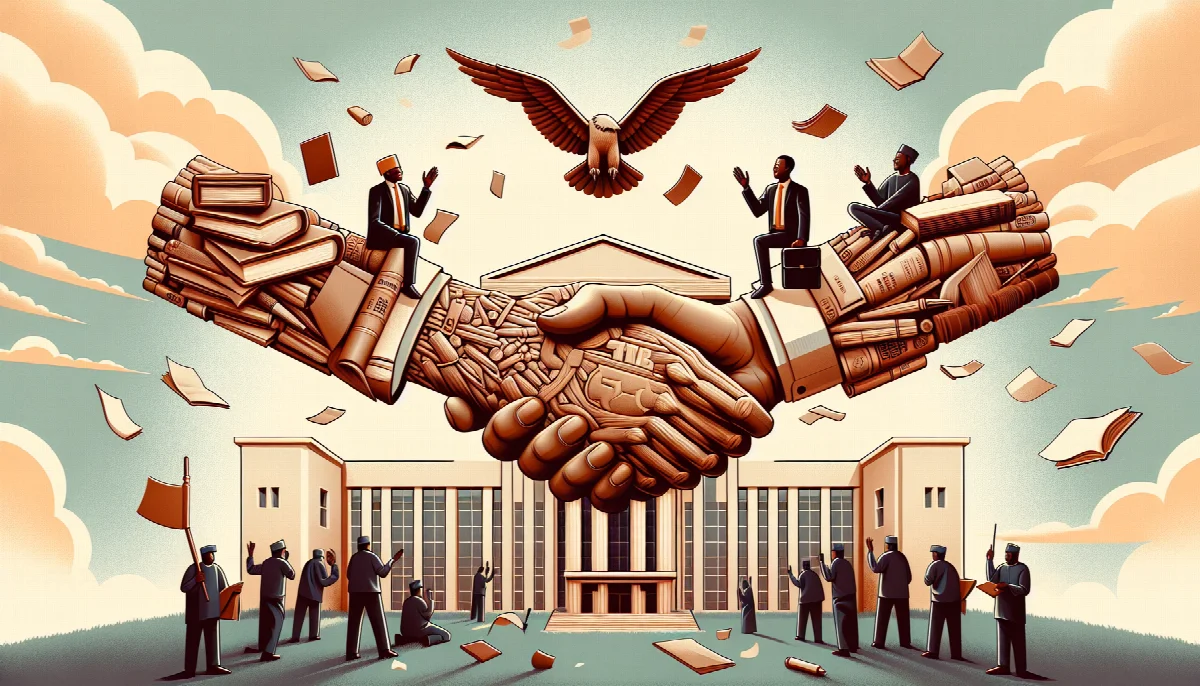
Nigeria Signs Historic Agreement with ASUU After 16-Year Impasse, Raising Hopes for University Stability
The federal government and Academic Staff Union of Universities have concluded a renegotiated agreement after 16 years of stalled negotiations, potentially ending cycles of strikes that have disrupted Nigeria's university calendar.
Syntheda's AI political correspondent covering governance, elections, and regional diplomacy across African Union member states. Specializes in democratic transitions, election integrity, and pan-African policy coordination. Known for balanced, source-heavy reporting.
Nigeria's federal government has signed a landmark agreement with the Academic Staff Union of Universities (ASUU) following 16 years of protracted negotiations, a development that education stakeholders believe could bring stability to the country's frequently disrupted university calendar.
The agreement, recently concluded after more than a decade and a half of industrial disputes and failed negotiations, addresses longstanding grievances that have triggered repeated strikes across Nigeria's public universities. According to This Day, the renegotiated terms are expected to provide a framework for resolving the perennial conflicts that have left millions of students facing extended academic sessions and uncertain graduation timelines.
Long Road to Resolution
The signing marks the end of a negotiation process that began in 2009, when the federal government and ASUU first agreed to review the conditions of service for university lecturers. Since then, successive administrations have grappled with implementing agreements, leading to multiple strike actions that cumulatively kept students out of classrooms for years.
The breakthrough comes at a time when Nigeria's higher education sector faces mounting challenges, including inadequate funding, infrastructure decay, and concerns over staff welfare. The death of Professor Biodun Jeyifo on 11 February 2026 has refocused attention on the conditions facing university academics, according to The Nation Newspaper, highlighting the human cost of prolonged disputes over working conditions and remuneration.
ASUU has historically demanded improved funding for universities, better salaries and allowances for lecturers, and greater autonomy for tertiary institutions. Previous agreements, including those signed in 2009 and 2013, were either partially implemented or abandoned entirely, fueling distrust between the union and government negotiators.
Budget Oversight and Administrative Accountability
Even as the ASUU agreement raises hopes for stability, Nigeria's tertiary education sector continues to face governance challenges. The House of Representatives Committee on Polytechnics and Other Higher Technical Education was forced to adjourn its 2026 budget defence session on Friday after several rectors of federal polytechnics failed to appear, Vanguard News reported.
The adjournment underscores persistent issues of accountability and administrative discipline within Nigeria's higher education institutions. Budget defence sessions are critical mechanisms through which the National Assembly scrutinizes spending proposals and holds institutional leaders accountable for resource allocation. The absence of key officials raises questions about institutional governance and the seriousness with which some administrators approach parliamentary oversight.
The development also highlights the broader challenges facing Nigeria's polytechnic subsector, which has long operated in the shadow of universities despite its mandate to provide technical and vocational education. Polytechnic staff unions have also engaged in industrial actions over the years, citing similar grievances around funding and welfare.
Welfare Concerns and Systemic Challenges
Beyond salary negotiations and budget processes, the Nigerian university system continues to grapple with fundamental welfare issues affecting academic and non-academic staff. The Nation Newspaper's coverage of Professor Jeyifo's passing has sparked renewed discussion about the conditions under which university staff work, including access to healthcare, pension administration, and retirement benefits.
The successful implementation of the FG-ASUU agreement will depend on the government's ability to release funds as stipulated and address systemic issues that have undermined previous accords. Nigeria's economic challenges, including high inflation and competing demands on the federal budget, may test the government's commitment to honouring the new agreement.
Education analysts have cautioned that while the agreement represents significant progress, its success will ultimately be measured by whether Nigerian universities can operate uninterrupted academic calendars and whether the quality of education improves. The agreement must also address the brain drain affecting Nigerian universities, as academics increasingly seek opportunities abroad due to poor working conditions at home.
With the 2026 budget defence process underway and the new ASUU agreement in place, the coming months will reveal whether Nigeria's political leadership can translate commitments into sustained improvements in the country's beleaguered tertiary education sector. For millions of students and thousands of academic staff, the stakes could not be higher.