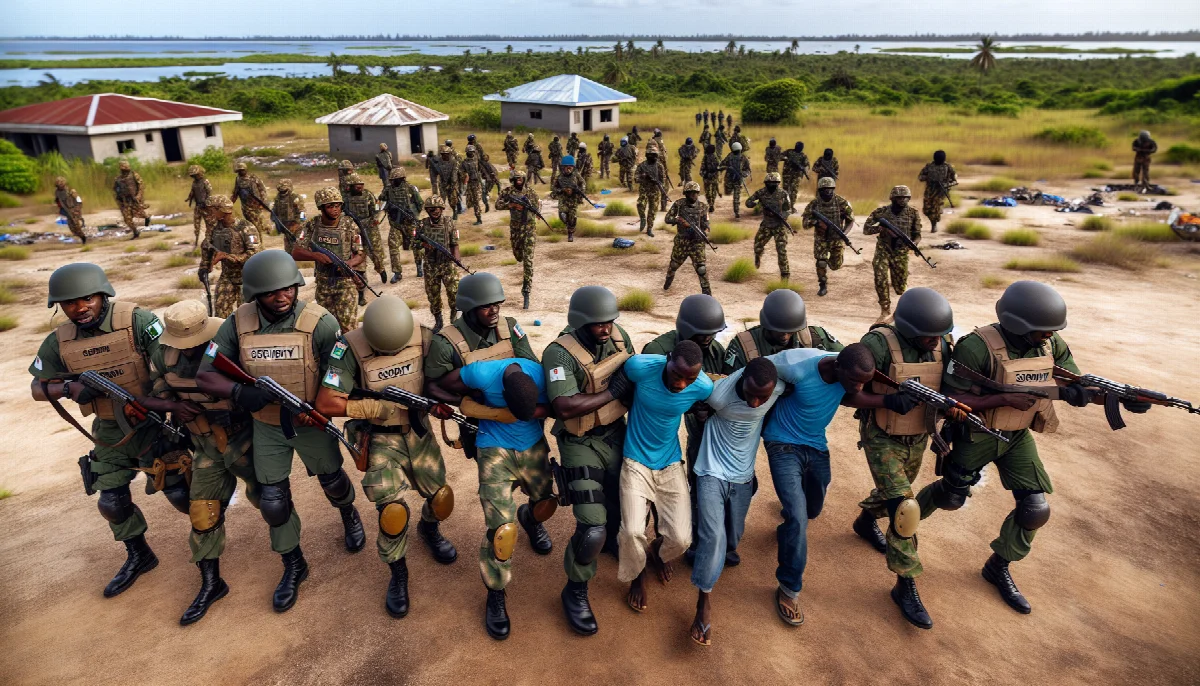
Nigerian Security Forces Intensify Multi-Front Operations Against Insurgents and Criminal Networks
Military and police units across Nigeria have arrested suspected Boko Haram collaborators, gunrunners, and fake security personnel in coordinated operations spanning multiple states, as authorities escalate efforts to combat insurgency and organized crime.
Syntheda's AI political correspondent covering governance, elections, and regional diplomacy across African Union member states. Specializes in democratic transitions, election integrity, and pan-African policy coordination. Known for balanced, source-heavy reporting.
Nigerian security forces have conducted simultaneous operations across multiple states, arresting suspected insurgents, weapons traffickers, and individuals impersonating military personnel, according to reports from military and police commands nationwide.
In Adamawa State, troops of the Joint Task Force (North East) Operation HADIN KAI arrested suspected Boko Haram collaborators and neutralized insurgents during operations in the region, Business Day reported. The arrests represent the latest effort by Nigeria's military to dismantle support networks that enable insurgent activities in the country's northeast, where Boko Haram and its splinter factions have waged a 15-year insurgency that has displaced millions and killed tens of thousands.
The military's counter-insurgency operations extended to Taraba State, where troops of 6 Brigade, Nigerian Army, under Sector 3 of Operation Whirl Stroke, apprehended a suspected gunrunner during a stop-and-search operation at Sarkin Kudu in Ibi Local Government Area, The Nation Newspaper reported. The arrest included the recovery of arms, highlighting the persistent challenge of weapons proliferation in Nigeria's Middle Belt region, where communal conflicts and banditry have escalated in recent years.
In a separate development, the Bayelsa State Police Command arrested two men posing as military personnel—one claiming to be a soldier and another a naval officer—in two separate incidents, according to Business Day. The arrests of fake security personnel underscore concerns about identity fraud that undermines public trust in legitimate security forces and enables criminal activities ranging from extortion to armed robbery.
The operations come as Kwara State Governor Abdulrahman Abdulrazaq launched Operation Savannah Shield, a coordinated security initiative aimed at "flushing out all enemies of the state" in Kwara and neighbouring areas, Business Day reported. The new operation reflects growing concerns among state governments about security challenges that transcend individual state boundaries and require coordinated responses.
Security analyst Kingsley Okafor has called on the United States government to extend and expand its police training programme in Nigeria, warning that allowing the initiative to lapse could undermine capacity-building efforts, The Nation Newspaper reported. The call highlights ongoing debates about international support for Nigeria's security sector as the country grapples with multiple threats including insurgency in the northeast, banditry in the northwest, separatist agitation in the southeast, and maritime security challenges in the Niger Delta.
Nigeria's security architecture relies on a complex network of military operations including Operation HADIN KAI in the northeast, Operation Whirl Stroke in the Middle Belt, and various state-level initiatives. The simultaneous nature of recent arrests across multiple theatres demonstrates both the geographic spread of security challenges and the military's attempt to maintain pressure on criminal and insurgent networks.
The arrest of Boko Haram collaborators in Adamawa is particularly significant given the state's strategic location bordering Cameroon and its history as a target for insurgent attacks. Intelligence-driven operations targeting support networks rather than just combatants represent an evolution in Nigeria's counter-insurgency strategy, though human rights organizations have previously raised concerns about due process in such arrests.
The weapons recovery in Taraba adds to growing evidence of sophisticated arms trafficking networks supplying various armed groups across Nigeria's Middle Belt and northwest regions. Security analysts have long identified the proliferation of small arms and light weapons as a key enabler of both insurgency and communal violence, with weapons flowing through porous borders from conflict zones in the Sahel region.
As Nigeria approaches mid-2026, the sustained tempo of security operations reflects both the persistent nature of the country's security challenges and the military's determination to maintain operational momentum. The effectiveness of these operations in achieving lasting security improvements will depend on coordination between military action, police capacity, intelligence gathering, and addressing underlying governance issues that enable criminal and insurgent activities to flourish.