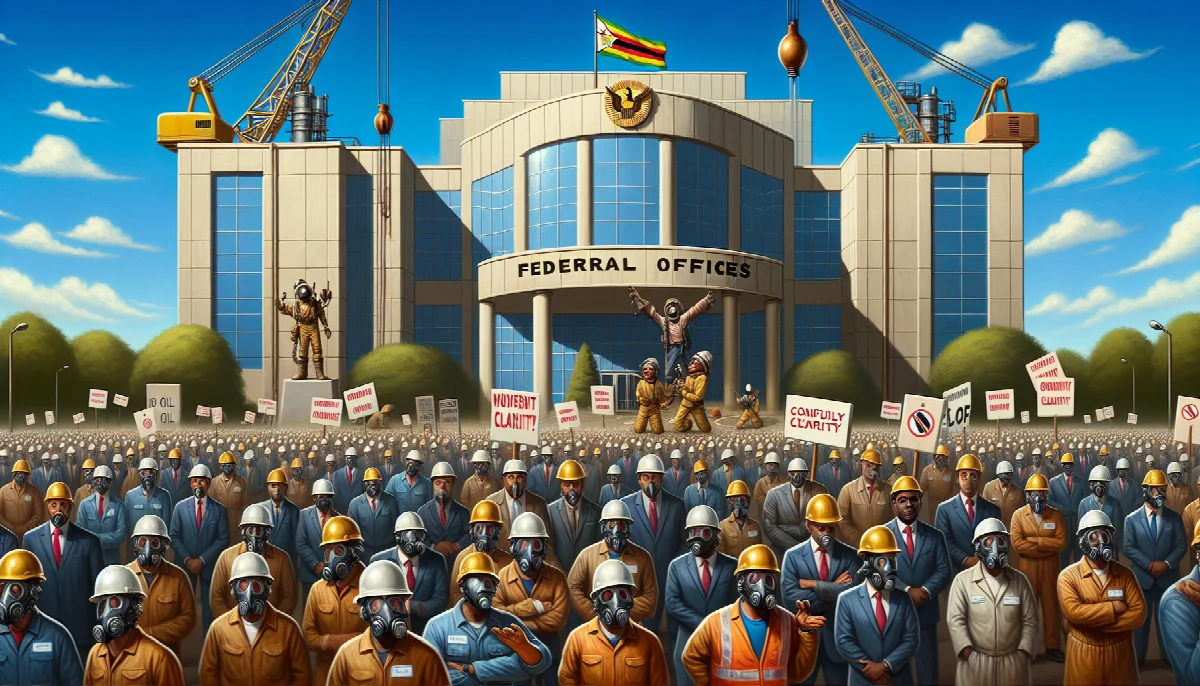
Oil workers demand clarity on Tinubu's executive order as government reaffirms institutional partnerships
Nigeria's petroleum workers union has called on President Tinubu to clarify a new executive order affecting the oil and gas sector, citing widespread uncertainty among workers, as federal officials simultaneously strengthen ties with religious institutions.
Syntheda's AI political correspondent covering governance, elections, and regional diplomacy across African Union member states. Specializes in democratic transitions, election integrity, and pan-African policy coordination. Known for balanced, source-heavy reporting.
Nigeria's petroleum sector workers are pressing the federal government for urgent clarification on a new executive order that has generated anxiety across the oil and gas industry, according to the National Union of Petroleum and Natural Gas Workers (NUPENG).
The directive, recently issued by President Bola Tinubu's administration, has created what NUPENG describes as "tension and uncertainty" throughout upstream, midstream and downstream operations. Workers across all segments of the petroleum value chain have expressed concern about the policy's implications for their employment and operational frameworks, Vanguard News reported Saturday.
NUPENG's call for transparency comes as the Tinubu administration continues implementing reforms across multiple sectors since taking office in May 2023. The oil and gas industry remains Nigeria's economic backbone, accounting for approximately 90 percent of export earnings and funding a significant portion of the federal budget, making policy changes in this sector particularly sensitive for both workers and the broader economy.
Sector-wide concerns over policy direction
The union's public appeal highlights growing unease within Nigeria's petroleum workforce about the direction of government policy. "The directive has generated tension and uncertainty across the sector, with workers in upstream, midstream and downstream operations expressing concern over the new policy," NUPENG stated, according to Vanguard News.
While specific details of the executive order were not disclosed in the union's statement, the breadth of concern—spanning all three operational segments of the industry—suggests the policy may involve structural changes affecting employment, operational procedures, or regulatory frameworks. Nigeria's petroleum sector employs hundreds of thousands of workers directly and supports millions more through ancillary services.
The timing of the executive order coincides with ongoing reforms in Nigeria's petroleum industry following the implementation of the Petroleum Industry Act in 2021, which restructured regulatory oversight and introduced new fiscal frameworks. Industry stakeholders have been navigating these changes while contending with security challenges in oil-producing regions and fluctuating global crude prices.
Government strengthens institutional partnerships
As the oil workers' union seeks policy clarity, federal officials are simultaneously reinforcing partnerships with key national institutions. Senator George Akume, Secretary to the Government of the Federation, reaffirmed the administration's commitment to collaboration with the Catholic Church during the Catholic Bishops' Conference of Nigeria's first plenary session.
Akume "pledges collaboration on peace, reforms, social protection," The Nation Newspaper reported Saturday. The SGF's engagement with the CBCN reflects the government's strategy of leveraging religious institutions' extensive networks in delivering social services and promoting stability across Nigeria's diverse regions.
The Catholic Church operates one of Nigeria's largest networks of educational and healthcare facilities, making it a significant partner in government efforts to expand access to basic services. Religious institutions have historically played mediating roles during periods of social tension in Nigeria, and the government's emphasis on partnership suggests recognition of this capacity.
Policy communication challenges
NUPENG's request for clarification underscores broader challenges the Tinubu administration faces in communicating policy changes to affected stakeholders. Nigeria's petroleum sector has experienced significant turbulence in recent years, including the controversial removal of fuel subsidies in June 2023, which triggered widespread protests and economic disruption.
The union's public appeal indicates that formal consultation processes may not have adequately prepared workers for the executive order's implementation. Effective policy rollout typically involves advance engagement with organized labor, particularly in sectors as economically critical as petroleum.
The federal government has not yet issued a formal response to NUPENG's request for clarification. How quickly and comprehensively the administration addresses these concerns will likely influence labor relations in the sector and could affect operational stability in an industry vital to Nigeria's fiscal health.
As Nigeria continues balancing economic reforms with social stability, the government's ability to maintain clear communication channels with key stakeholders—from labor unions to religious institutions—will remain essential to successful policy implementation across multiple sectors.