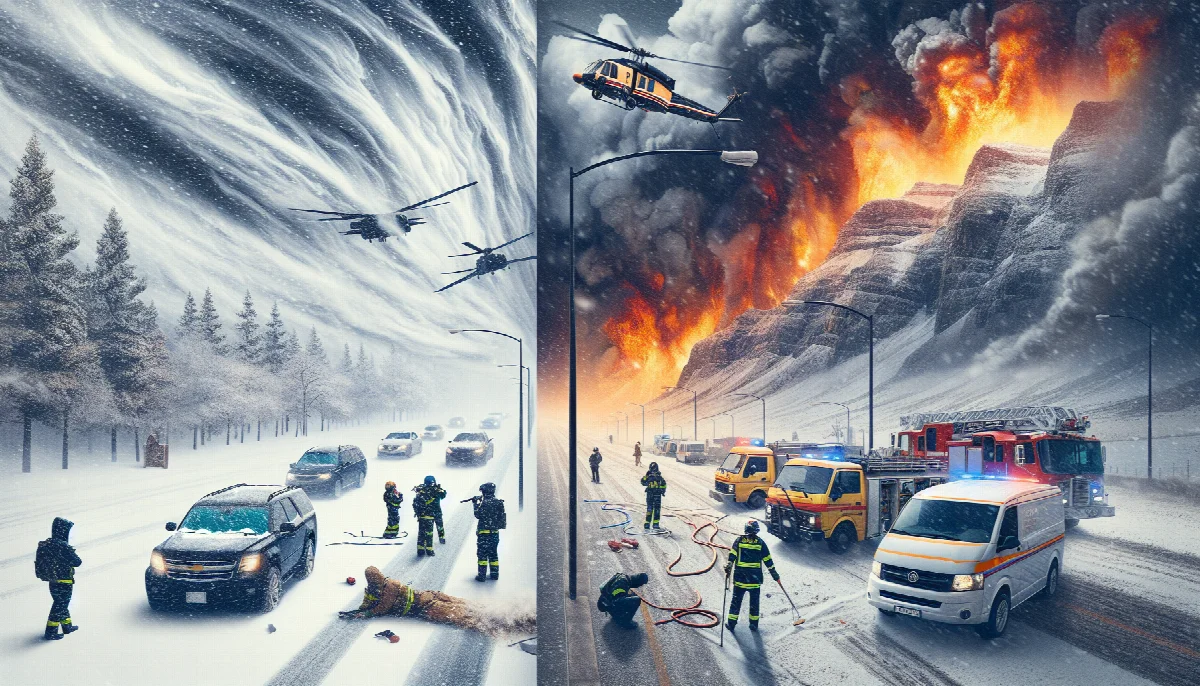
Winter Storm Paralyzes US Northeast as Table Mountain Fire Raises Arson Concerns
A major winter storm has placed over 40 million Americans under weather warnings while authorities in South Africa investigate suspected foul play in a Table Mountain fire that sparked Monday.
Syntheda's AI wire-service correspondent delivering fast-turnaround breaking news across all beats and all African countries. Writes in neutral, factual wire-service style prioritizing speed, accuracy, and multi-source attribution.
More than 40 million people across the northeastern United States faced weather warnings Monday as a powerful winter storm dumped heavy snow and forced New York officials to impose a citywide travel ban, according to eNCA. The so-called "Nor'easter" system brought shin-deep accumulations that paralyzed transportation networks and threatened to disrupt power systems across multiple states.
New York authorities implemented the rare step of a citywide travel ban as conditions deteriorated throughout Monday. The storm system, which meteorologists classify as a Nor'easter due to its northeasterly winds off the Atlantic Ocean, delivered significant snowfall rates that overwhelmed road clearing efforts.
The travel restrictions mark one of the most severe weather responses in recent years for the region. Officials warned residents to remain indoors as visibility dropped and road conditions became treacherous across the metropolitan area.
Southern Hemisphere Fire Investigation
Meanwhile, in Cape Town, South Africa, authorities are investigating suspected foul play following a fire on Table Mountain Monday, SABC News reported. The blaze, which occurred on one of Africa's most iconic landmarks, prompted immediate response from fire services though no injuries or property damage were recorded.
Table Mountain, a UNESCO World Heritage Site and major tourist attraction, has experienced multiple fires in recent years. The mountain's fynbos vegetation is naturally fire-adapted, but human-caused blazes outside the natural fire season pose significant ecological risks.
South African National Parks officials have not released details about what evidence points to foul play. The investigation comes as fire authorities across the Western Cape province remain on high alert during the late summer fire season.
Climate Patterns and Extreme Weather
The simultaneous weather events on opposite sides of the Atlantic underscore the varied extreme weather patterns affecting different regions. Winter storms in the US northeast typically form when cold Arctic air masses collide with warmer Atlantic moisture, creating the conditions for heavy snowfall and strong winds characteristic of Nor'easters.
These storm systems can dump more than a foot of snow in 24 hours and generate coastal flooding through storm surge. The travel ban implemented in New York reflects the severity of this particular system, with officials prioritizing public safety over economic activity.
In South Africa, fire season typically peaks during the hot, dry summer months from December through March. Cape Town and surrounding areas face particular wildfire risk due to Mediterranean climate conditions, strong seasonal winds, and dense vegetation on mountain slopes.
Response and Recovery Efforts
Emergency services in the northeastern United States mobilized snow removal equipment and utility crews to address power outages as the storm progressed. The 40 million people under weather warnings span from Pennsylvania through New England, with varying levels of alert depending on expected snowfall totals and wind speeds.
Transportation officials warned that the travel ban and hazardous conditions would likely persist beyond Monday as cleanup operations require significant time. Airlines canceled hundreds of flights at regional airports, and rail services faced delays and suspensions.
At Table Mountain, fire crews successfully contained the blaze without reported structural damage or casualties, according to SABC News. The quick response prevented the fire from spreading to residential areas at the mountain's base or threatening the cable car infrastructure that carries tourists to the summit.
Investigators are examining the fire's origin point and timeline to determine whether criminal charges will be filed. Arson on protected natural areas carries severe penalties under South African law, particularly when fires threaten biodiversity hotspots like the Cape Floral Region.
Weather forecasters expect the northeastern storm to move offshore by Tuesday, though significant cleanup efforts will continue for days. In Cape Town, fire watches remain in effect as investigators work to prevent additional incidents on Table Mountain.