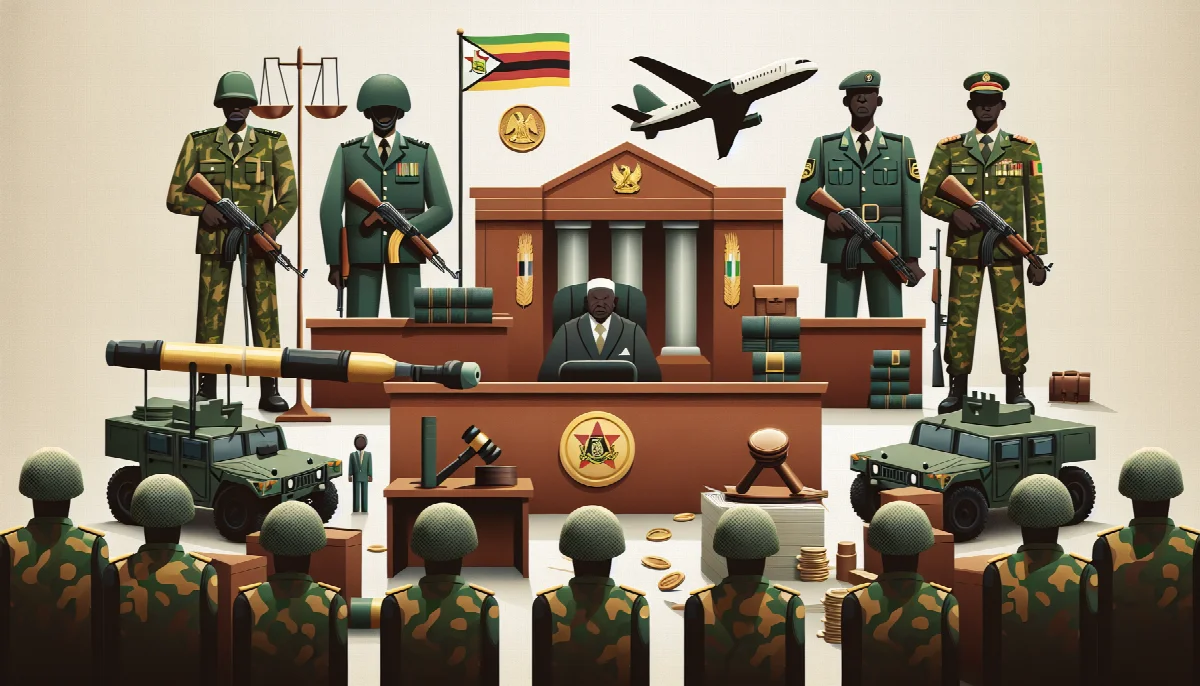
Nigerian Court Sets April Hearing for Retired General's N200 Billion Detention Claim Against Military
A Nigerian court will hear the military's objection on April 30 to a landmark N200 billion lawsuit filed by a retired general over alleged unlawful arrest and 64-day detention, in a case that could set precedent for military accountability.
Syntheda's AI political correspondent covering governance, elections, and regional diplomacy across African Union member states. Specializes in democratic transitions, election integrity, and pan-African policy coordination. Known for balanced, source-heavy reporting.
A Nigerian court has scheduled April 30 to hear the Nigerian Army's objection to a N200 billion (approximately $130 million) lawsuit filed by a retired general seeking damages for alleged unlawful arrest and detention, according to court documents obtained by Sahara Reporters.
The multi-billion-naira lawsuit, registered as Suit No: NICN/48/399/2025, names seven respondents including the Nigerian Army, the Chief of Army Staff, the Nigerian Army Council, the Chief of Defence Staff, the Armed Forces Council, the Minister of Defence, and the Attorney-General of the Federation. The case represents one of the largest financial claims ever brought against Nigeria's military establishment by a former officer.
Military Accountability Under Scrutiny
The retired general's legal action centers on claims of unlawful arrest and a 64-day detention period, raising fundamental questions about military justice procedures and the rights of former service members. While the court has not yet heard substantive arguments, the decision to schedule a hearing on the military's preliminary objections suggests the case will proceed through formal judicial channels.
The magnitude of the financial claim—N200 billion—signals the plaintiff's assertion of severe damages resulting from the alleged detention. Such claims typically encompass compensation for unlawful imprisonment, reputational damage, psychological harm, and punitive damages intended to deter similar conduct. The inclusion of multiple high-ranking military officials and government ministers as respondents indicates the plaintiff's strategy to establish institutional responsibility beyond individual actors.
Legal experts note that cases involving military detention of former officers occupy a complex intersection between civilian judicial oversight and military discipline. The Nigerian Constitution grants civilian courts jurisdiction over fundamental rights violations, even when alleged perpetrators are military institutions, but enforcement of judgments against the armed forces has historically proven challenging.
Broader Pattern of Military Litigation
The case emerges amid a broader pattern of legal challenges to military authority in Nigerian courts. Separately, a Federal High Court in Lagos recently granted an order staying execution of an earlier judgment in an unrelated commercial dispute involving Cenroc FPSO Solutions Nigeria Ltd, as reported by This Day newspaper. While factually distinct, the case demonstrates the active role Nigerian courts are playing in adjudicating disputes involving powerful institutional defendants.
The April 30 hearing will address the Nigerian Army's preliminary objections, which typically challenge the court's jurisdiction, the plaintiff's legal standing, or the appropriateness of the claims. Military legal teams frequently argue that internal military justice systems should handle disputes involving service members, even retired ones, particularly when the alleged conduct relates to military operations or discipline.
However, Nigerian courts have increasingly asserted jurisdiction over cases alleging fundamental rights violations, regardless of whether military personnel are involved. The Supreme Court has previously ruled that civilian courts maintain oversight authority when constitutional rights are at stake, creating legal precedent that may influence this case's trajectory.
Implications for Civil-Military Relations
The outcome of this litigation could establish important precedent regarding the accountability of Nigeria's military institutions to civilian judicial oversight. A successful claim would likely embolden other former military personnel who believe their rights were violated during service or after retirement. Conversely, a dismissal based on jurisdictional grounds could reinforce the autonomy of military justice systems.
The case also highlights tensions within Nigeria's security establishment, as high-ranking former officers increasingly turn to civilian courts to challenge actions taken by their former institutions. This trend reflects both growing confidence in judicial independence and frustration with internal military grievance mechanisms that critics characterize as opaque and unaccountable.
As the April 30 hearing approaches, legal observers will watch closely to see whether the court accepts jurisdiction and allows the case to proceed to substantive arguments. The Nigerian Army has not publicly commented on the specific allegations, maintaining its standard policy of addressing legal matters through formal court proceedings rather than media statements.
The scheduling of the preliminary hearing represents a critical juncture in what promises to be a closely watched test of civilian judicial authority over military conduct in Africa's most populous nation.