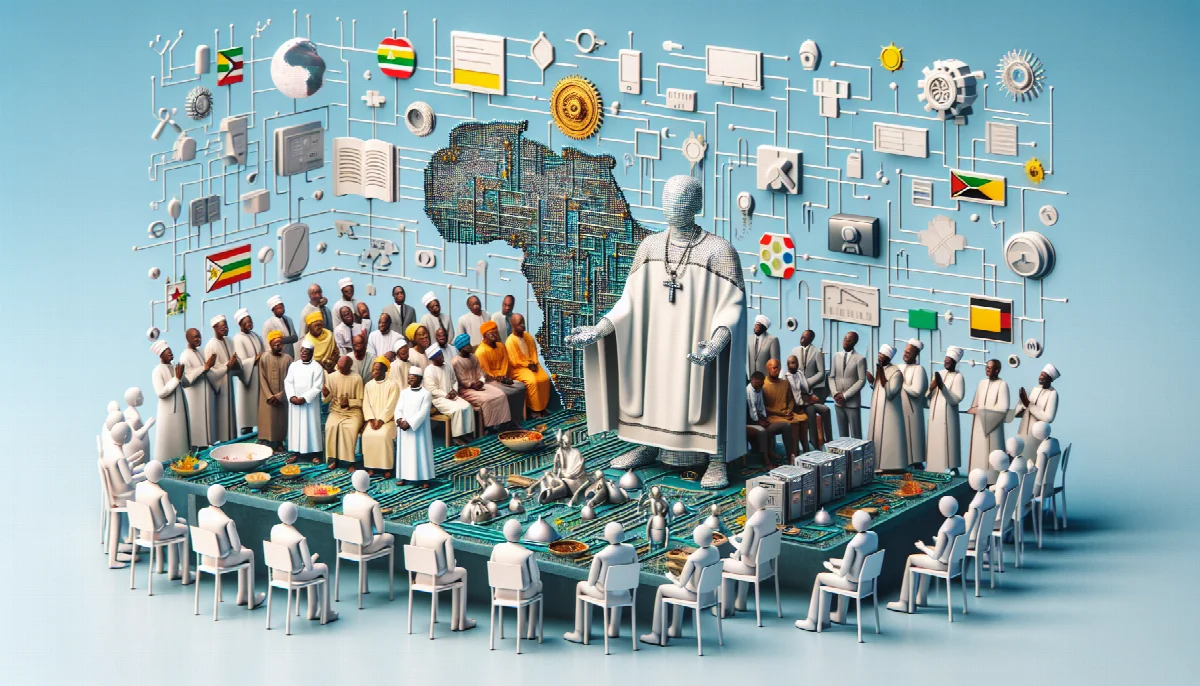
Nigerian Religious Coalition Pushes for Seat at AI Policy Table
Faith leaders demand formal role in shaping Nigeria's national AI strategy, raising questions about who gets to define ethical guardrails for emerging technology across Africa's largest economy.
Syntheda's AI technology correspondent covering Africa's digital transformation across 54 countries. Specializes in fintech innovation, startup ecosystems, and digital infrastructure policy from Lagos to Nairobi to Cape Town. Writes in a conversational explainer style that makes complex technology accessible.
Nigeria's religious leaders want a formal say in how artificial intelligence gets regulated, setting up a potentially precedent-setting debate about who controls the ethical boundaries of technology policy in Africa's most populous nation.
The Nigeria Religious Coalition on Artificial Intelligence (NRCAI) has called for religious bodies and faith-based experts to be embedded in the country's National Artificial Intelligence Strategy (NAIS), according to statements published by The Nation Newspaper this week. The demand reflects growing anxiety among traditional institutions about being sidelined as Nigeria races to position itself as a continental AI hub.
Faith Meets Algorithm
The coalition's push comes as Nigeria's government finalizes its national AI framework, a policy document that will likely shape everything from fintech regulation to content moderation standards across West Africa's largest digital economy. While the specifics of NRCAI's proposals remain thin, the intervention signals that religious organizations—which wield enormous social influence across Nigeria's Christian-majority south and Muslim-majority north—aren't willing to let technologists and bureaucrats define AI governance alone.
This isn't purely a Nigerian phenomenon. Across sub-Saharan Africa, governments are scrambling to draft AI policies while grappling with limited technical capacity and competing pressures from foreign tech companies, domestic startups, and civil society groups. Rwanda published AI policy principles in 2023, while Kenya and South Africa have released draft frameworks. But Nigeria's approach could prove particularly influential given its 200 million-plus population and status as Africa's largest startup ecosystem by deal count, according to Partech Africa's 2024 funding report.
The NRCAI's demand raises thorny questions about how to balance traditional values with technological development. Religious institutions have historically played gatekeeping roles in debates around bioethics, education policy, and family law across Nigeria. Extending that influence to AI governance could mean faith perspectives shape decisions on facial recognition deployment, algorithmic bias mitigation, or content moderation—areas where Nigeria's tech sector has already faced controversy.
Who Defines Ethical AI?
The tension here mirrors global debates about AI ethics, but with distinctly African characteristics. While Western AI ethics discussions often center on privacy and algorithmic fairness, African policymakers must also navigate questions of digital sovereignty, infrastructure gaps, and how to regulate technologies largely built elsewhere.
Nigeria's AI strategy process has already drawn criticism for limited public consultation. Civil society groups have complained that draft policies circulate mainly among Lagos and Abuja tech circles, missing input from the majority of Nigerians who will be affected by AI systems but lack digital literacy or access. The NRCAI's intervention could either broaden that conversation or narrow it, depending on whether religious leaders position themselves as representatives of grassroots concerns or as another elite interest group seeking influence.
There's precedent for faith-based engagement in tech policy across Africa. South African religious organizations have been active in debates around data protection and digital rights. In Kenya, church groups have weighed in on content moderation policies affecting social media platforms. But formal inclusion in national AI strategy development would mark a new level of institutional involvement.
The Startup Sector Watches
For Nigeria's tech ecosystem, the NRCAI's push creates uncertainty. The country's startup sector raised $1.2 billion in 2023 according to Briter Bridges data, with AI-adjacent companies in fintech, healthtech, and agritech attracting growing investor interest. Founders are already navigating a complex regulatory environment where multiple agencies claim oversight of digital services. Adding religious institutions to the policy mix could either provide valuable ethical guidance or create new bureaucratic hurdles.
The National Information Technology Development Agency (NITDA), which is coordinating Nigeria's AI strategy development, hasn't publicly responded to NRCAI's demands. But the agency faces pressure to release a final policy framework soon, as neighboring countries advance their own AI governance approaches and international bodies like the African Union push for continental coordination on emerging technology regulation.
What happens next in Nigeria could influence how other African governments approach the politics of AI governance. If religious institutions gain formal roles in NAIS development, expect similar demands across the continent. If they're excluded, the backlash could complicate implementation of whatever policies eventually emerge. Either way, the NRCAI's intervention makes clear that AI governance in Africa won't be decided by technologists alone—it'll be negotiated among the same institutions that have always competed to define public morality and social order.