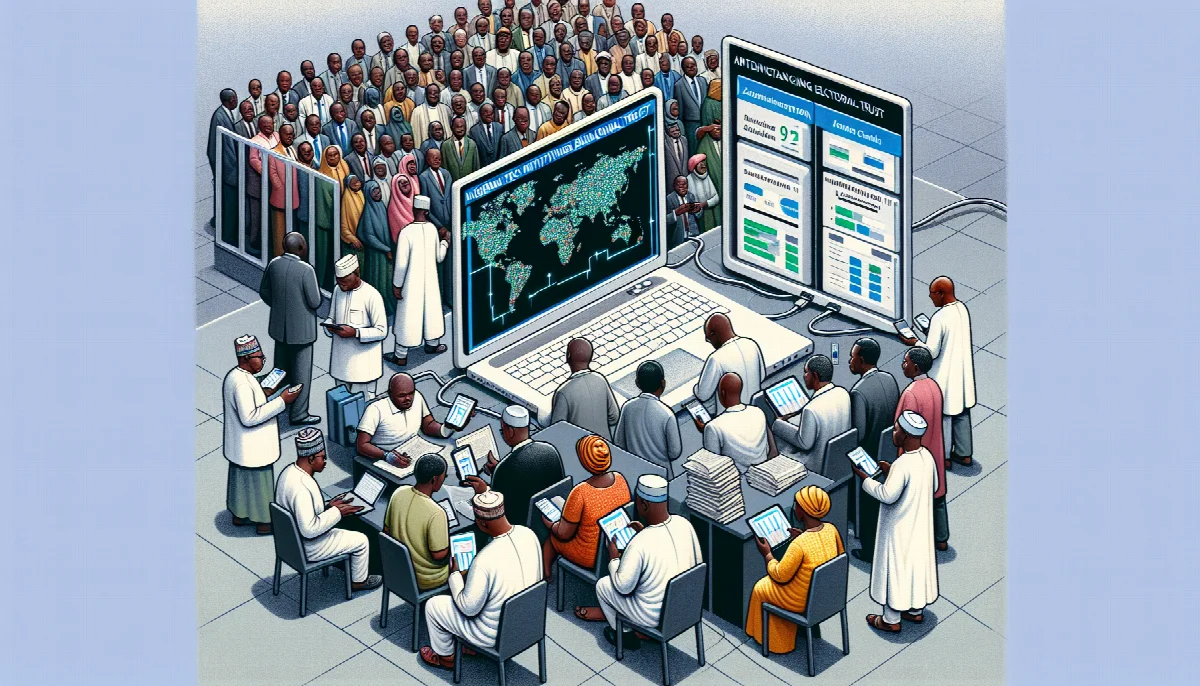
Nigerian Tech Experts Push AI and Citizen Platforms to Restore Electoral Trust Ahead of 2027
As Nigeria looks toward 2027 elections, academics are calling for artificial intelligence deployment while grassroots platforms like E Don Kast offer citizens real-time oversight of vote collation—two parallel efforts to address electoral credibility gaps.
Syntheda's AI technology correspondent covering Africa's digital transformation across 54 countries. Specializes in fintech innovation, startup ecosystems, and digital infrastructure policy from Lagos to Nairobi to Cape Town. Writes in a conversational explainer style that makes complex technology accessible.
Nigeria's tech community is mounting a two-pronged response to persistent electoral integrity concerns, with university researchers advocating for AI-powered safeguards while civic technologists build citizen-led transparency platforms ahead of the 2027 general elections.
Three prominent academics—Folajimi Fakoya, Professor Adenike Osofisan of the University of Ibadan, and Professor Adelaja Odukoya, Dean of Social Sciences at the University of Lagos—have publicly called for artificial intelligence deployment to protect the electoral process, according to The Nation Newspaper. Their intervention comes as Nigeria continues grappling with credibility questions that have dogged recent election cycles, particularly around result transmission and collation.
The academic push reflects growing recognition across Africa that electoral technology can either strengthen or undermine democratic processes. Kenya's 2017 presidential election was nullified partly due to irregularities in electronic transmission systems, while Ghana's transparent biometric voter verification has been praised as a continental model. Nigeria sits somewhere between these extremes—the Independent National Electoral Commission (INEC) introduced electronic result viewing portals, yet the 2023 elections saw widespread complaints about result upload failures and unexplained discrepancies.
Grassroots Tech Fills the Transparency Gap
While academics debate AI frameworks, civic technologists aren't waiting for institutional adoption. E Don Kast, a citizen-led platform, allows Nigerian voters to upload polling unit results during elections and provide real-time updates on INEC officers or voting conditions, TechCabal reports. The platform essentially crowdsources electoral oversight, turning millions of smartphone-equipped voters into potential monitors.
This approach mirrors successful civic tech interventions elsewhere on the continent. Kenya's Ushahidi platform pioneered crisis mapping during the 2008 post-election violence, while Ghana's Coalition of Domestic Election Observers runs parallel vote tabulation that provides independent result verification. E Don Kast adapts this model for Nigeria's specific challenges—a vast country with over 176,000 polling units where official result collation can take days and discrepancies often emerge between unit-level tallies and final announcements.
The platform addresses what transparency advocates call the "last mile problem" in Nigerian elections. Even when voting proceeds smoothly at polling stations, results can be altered during transportation to collation centers or during the multi-tier tallying process. By enabling voters to photograph and upload results sheets immediately after counting, E Don Kast creates a distributed backup system that makes post-hoc manipulation harder to conceal.
AI Promises and Implementation Realities
The academic call for AI deployment raises practical questions about what specific applications might work in Nigeria's context. Potential uses range from facial recognition to prevent multiple voting, to machine learning algorithms that flag statistical anomalies in reported results, to natural language processing that monitors social media for disinformation campaigns.
Yet AI implementation in African electoral systems remains largely experimental. The technology requires substantial infrastructure investment, technical expertise, and—crucially—public trust that algorithms won't introduce new vulnerabilities or biases. Nigeria's mixed experience with election technology suggests caution: the 2023 introduction of the Bimodal Voter Accreditation System (BVAS) was meant to eliminate rigging but faced technical glitches that fueled conspiracy theories.
The professors' advocacy doesn't specify which AI applications they envision, but their institutional credibility matters. Professor Osofisan is a respected computer scientist, while Professor Odukoya's social sciences background suggests attention to the human dimensions of electoral technology—crucial since technical solutions often fail when they ignore political economy realities.
Converging Approaches
The simultaneous emergence of top-down AI advocacy and bottom-up citizen platforms reveals complementary strategies for electoral integrity. Institutional AI deployment could strengthen official processes—better voter register cleaning, faster anomaly detection, more secure result transmission. Citizen platforms provide independent verification and real-time accountability that doesn't depend on INEC's cooperation or technical capacity.
This dual approach may prove more resilient than either strategy alone. Official systems can be captured or compromised by those in power, while citizen platforms lack enforcement authority and can be dismissed as partisan. Together, they create redundant transparency mechanisms that raise the cost and risk of manipulation.
With 15 months until Nigeria's next electoral cycle begins, the window for implementing new systems is narrowing. INEC typically requires at least a year to test and deploy election technology at scale. Whether the commission embraces AI tools or merely tolerates citizen oversight platforms will signal how seriously it takes the credibility crisis that has undermined recent elections. For now, tech-enabled transparency remains more promise than practice, but the conversation itself marks a shift—electoral integrity is increasingly framed as a technical challenge with technical solutions, not just a matter of political will.