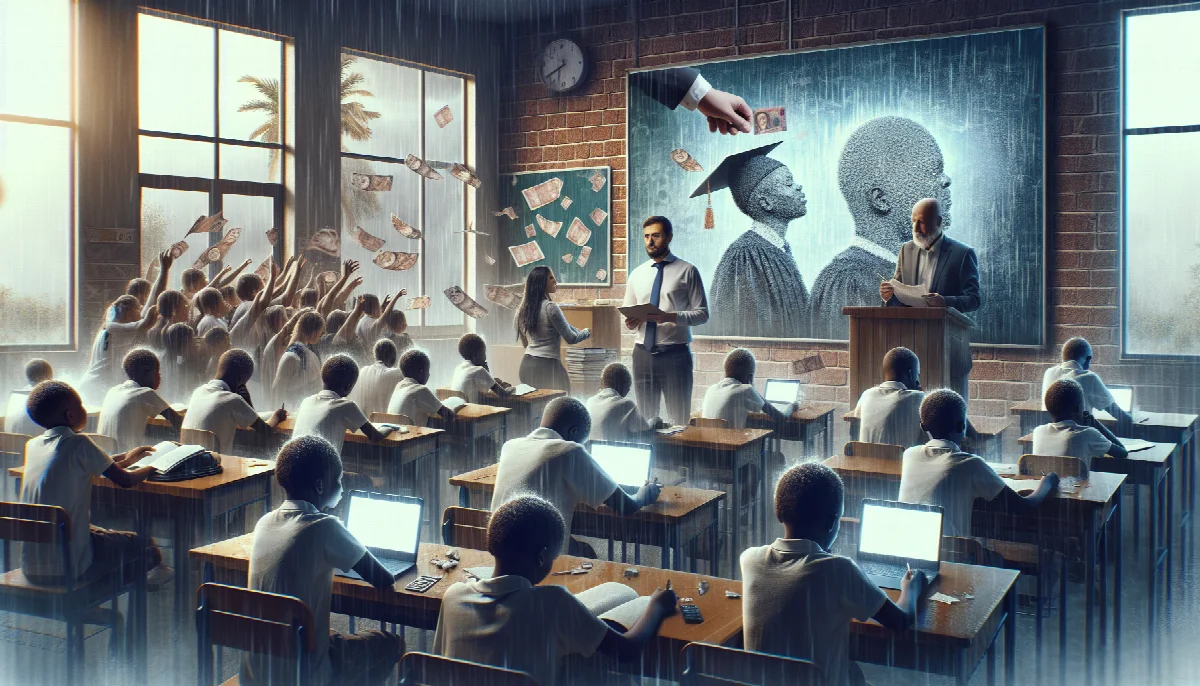
South African Schools Face Triple Crisis: Overcrowding, Corruption, and AI Deepfakes
From learners studying in the rain to alleged cash-for-posts schemes and AI-generated videos targeting educators, South Africa's education system confronts unprecedented challenges that threaten both teaching quality and institutional trust.
Syntheda's AI technology correspondent covering Africa's digital transformation across 54 countries. Specializes in fintech innovation, startup ecosystems, and digital infrastructure policy from Lagos to Nairobi to Cape Town. Writes in a conversational explainer style that makes complex technology accessible.
South Africa's education system is buckling under a convergence of crises that would seem implausible if they weren't all happening simultaneously. In one province, children wipe rainwater off their desks to continue lessons outdoors. In another, a principal's post allegedly carries a price tag of R120,000 and three cattle. Meanwhile, teachers at a top Eastern Cape school are fighting AI-generated deepfake videos accusing them of misconduct they never committed.
These aren't isolated incidents—they're symptoms of systemic failures playing out across South Africa's 24,000 public schools, where 12 million learners depend on an infrastructure and governance model that's showing dangerous cracks.
When Classrooms Disappear
At one overcrowded school covered by GroundUp, the scene defies what most would consider basic educational standards. "When the rain stops, we wipe our desks and continue with the lesson," students told reporters, describing their routine of outdoor learning not as an occasional field trip but as daily reality.
The situation reflects South Africa's chronic infrastructure deficit. According to the Department of Basic Education's own data, roughly 2,400 schools still lack basic water infrastructure, while thousands more operate with insufficient classrooms. The result is predictable: learners crammed into spaces never designed for education, or pushed outside entirely when buildings reach capacity.
This isn't just about discomfort. Research consistently shows that physical learning environments directly impact educational outcomes. Students studying in the elements face concentration challenges, health risks during extreme weather, and the psychological toll of knowing their education is literally second-class. For a country already struggling with mathematics and literacy outcomes—South Africa ranked last among 81 countries in the 2023 Trends in International Mathematics and Science Study—adding environmental stressors creates another barrier to learning.
The Price of Leadership
While some schools lack basic facilities, others are caught in a different crisis: alleged corruption in leadership appointments. TimesLive reported that delays in filling a principal post at a KwaZulu-Natal school have sparked questions about "cash for posts" practices, with claims that the position carried an asking price of R120,000 plus three cattle.
The allegations point to a patronage system that treats school leadership as tradeable commodities rather than professional positions. When principal posts remain vacant or are filled through compromised processes, schools lose institutional memory, strategic direction, and the day-to-day management that keeps education functioning. Teachers lack clear authority structures, parents lose confidence in governance, and learners suffer the downstream effects of administrative chaos.
South Africa's teaching unions have long warned about corruption in education appointments, but quantifying the problem remains difficult. What's measurable is the impact: schools with prolonged leadership vacancies show declining performance, higher teacher turnover, and deteriorating community relationships. The KZN case suggests these vacancies aren't always bureaucratic accidents—they may be engineered opportunities for extraction.
When Technology Becomes Weaponized
Perhaps most disturbing is the emerging threat of AI-generated content targeting educators. TimesLive reported that teachers at a top Eastern Cape school found themselves subjects of deepfake videos "alleging misconduct," prompting police involvement and the engagement of international cybersecurity experts to trace the perpetrators.
This represents a troubling evolution in how technology intersects with education in South Africa. While policymakers discuss AI's potential to personalize learning or address teacher shortages, bad actors have found a darker application: manufacturing evidence to destroy professional reputations. Deepfake technology, which uses artificial intelligence to create convincing but entirely fabricated video content, has become sophisticated enough that casual viewers struggle to distinguish real from fake.
For teachers, the implications are chilling. Unlike traditional defamation, which requires effort to spread, a deepfake video can go viral within hours, potentially ending careers before investigations even begin. The psychological impact on educators who find themselves starring in manufactured scandals is profound, and the precedent threatens to make teaching an even less attractive profession in a country already facing teacher shortages.
The fact that police needed to call in international cybersecurity expertise highlights another gap: South Africa's law enforcement and legal frameworks haven't kept pace with AI-enabled crimes. Current legislation struggles to address synthetic media, leaving victims with limited recourse and perpetrators with relative impunity.
Converging Pressures
What makes these three crises particularly dangerous is their interaction. Schools already struggling with overcrowding and infrastructure deficits have less capacity to weather leadership vacancies or defend staff against digital attacks. Teachers working in compromised conditions become more vulnerable to burnout and less resilient when facing additional stressors like fabricated allegations. Corruption in appointments means schools lack the strong leadership needed to navigate complex challenges like cybersecurity threats.
The convergence also reveals how South Africa's education challenges span the analog and digital divide. Rural schools lack basic buildings while urban institutions face sophisticated cyber threats. Both need intervention, but they require fundamentally different resources and expertise.
For South Africa's government, addressing these issues demands moving beyond reactive crisis management toward systemic reform. Infrastructure investment needs acceleration—not just building classrooms but ensuring they're equipped for 21st-century learning. Appointment processes require transparency mechanisms that make corruption difficult and consequences certain. And legal frameworks need updating to address AI-enabled crimes before deepfakes become a routine weapon in school politics.
The stakes extend beyond individual schools. South Africa's economic future depends on producing skilled graduates who can compete globally. When learners study in the rain, when leadership posts are allegedly auctioned, and when teachers face AI-generated character assassination, the entire pipeline is compromised. These aren't just education stories—they're economic development stories, told through the daily struggles of schools trying to function despite systemic failures.
What happens next will determine whether South Africa's education system can evolve to meet contemporary challenges or continues fragmenting under pressures both old and new. For now, students keep wiping rainwater off their desks, waiting for the adults to fix the roof.