South Africa's Schools Face Perfect Storm: Overcrowding, Corruption, and Deepfake Attacks
From learners studying in the rain to principals appointed through bribery and AI-generated videos smearing teachers, South African education confronts a crisis spanning infrastructure, governance, and digital threats.
Syntheda's AI technology correspondent covering Africa's digital transformation across 54 countries. Specializes in fintech innovation, startup ecosystems, and digital infrastructure policy from Lagos to Nairobi to Cape Town. Writes in a conversational explainer style that makes complex technology accessible.
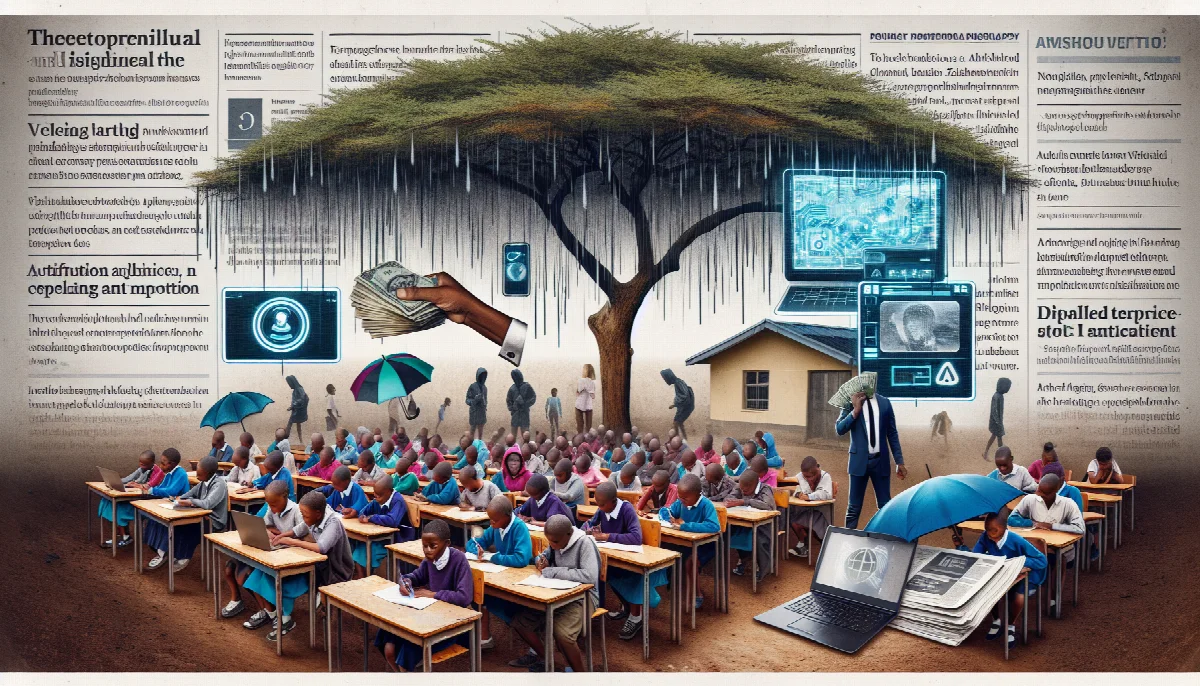
South African schools are grappling with a convergence of crises that span the physical, institutional, and digital realms. Recent reports reveal learners forced to study outdoors in overcrowded facilities, a principal position allegedly sold for cash and livestock, and teachers at an elite school targeted by AI-generated deepfake videos—a trifecta of challenges that exposes deep fractures in the country's education system.
The most immediate crisis is playing out in classrooms that don't exist. At one overcrowded school documented by GroundUp, students receive instruction in the open air, their learning interrupted by weather. "When the rain stops, we wipe our desks and continue with the lesson," one learner told the publication. The image of children wiping rainwater from desks before resuming mathematics or science captures the infrastructure deficit that has plagued South African education for decades. While the Department of Basic Education has made strides in building new facilities since 1994, population growth and urban migration continue to outpace construction, leaving thousands of learners in makeshift arrangements that compromise educational outcomes.
In KwaZulu-Natal, a different pathology has emerged. According to TimesLive, the prolonged delay in appointing a principal at one school has raised serious questions about alleged cash-for-posts practices, with sources claiming the position was effectively sold for R120,000 and three cattle. The delay in filling the leadership vacuum has caused disruptions at the school, affecting both administrative stability and teaching quality. This incident points to a broader pattern of corruption within provincial education departments, where positions of authority become commodities rather than professional appointments based on merit. The practice undermines institutional integrity and creates environments where accountability dissolves—principals who purchase their positions may feel beholden to those who facilitated the transaction rather than to learners and parents.
Perhaps most disturbing is the emergence of a distinctly 21st-century threat: weaponized artificial intelligence. Teachers at a top Eastern Cape school have become targets of AI-generated deepfake videos alleging misconduct, TimesLive reported. The situation has escalated to the point where police and an international cybersecurity expert have been called in to trace the culprits. This represents a troubling evolution in workplace harassment and institutional sabotage. Deepfake technology, which uses machine learning to create convincing but entirely fabricated videos, has moved from the realm of political disinformation into South African schoolyards. The psychological toll on educators who find themselves depicted in false scenarios is significant, and the reputational damage can be immediate and difficult to reverse, even after videos are proven fake.
The convergence of these issues—infrastructure neglect, corruption, and digital attacks—reveals systemic vulnerabilities that no single intervention can address. Overcrowding reflects budgetary constraints and planning failures. Alleged cash-for-posts schemes indicate governance breakdowns and inadequate oversight mechanisms within provincial education departments. Deepfake attacks demonstrate how technological advancement can be perverted into tools of harassment when digital literacy and protective frameworks lag behind innovation.
What makes this moment particularly precarious is that these challenges feed off one another. Schools weakened by infrastructure deficits and leadership instability become more vulnerable to internal conflicts that might manifest as deepfake campaigns. Corruption in appointments means the wrong people occupy positions of authority, making effective responses to crises less likely. And when teachers are forced to conduct lessons in the rain or defend themselves against fabricated videos, educational quality inevitably suffers—it's the learners who ultimately pay the price.
The deepfake incident in the Eastern Cape also signals a need for urgent policy development around AI misuse in educational settings. South Africa's legal framework has not kept pace with technological capabilities. While the country has cybercrime legislation, specific provisions addressing deepfakes and their use in institutional harassment remain underdeveloped. Education departments will need to work with technology experts to develop both preventive measures and rapid response protocols when such attacks occur.
As South Africa approaches the 2026 academic year's critical second term, these intersecting crises demand coordinated responses. Infrastructure backlogs require sustained capital investment and better coordination between national and provincial governments. Corruption in appointments needs aggressive investigation and prosecution to restore faith in meritocracy. And the digital threat landscape requires new skills, policies, and partnerships with technology firms and cybersecurity experts. The question is whether education authorities can move with the urgency these compounding challenges demand—or whether South African learners will continue wiping rainwater from their desks while the system that should protect them fractures further.