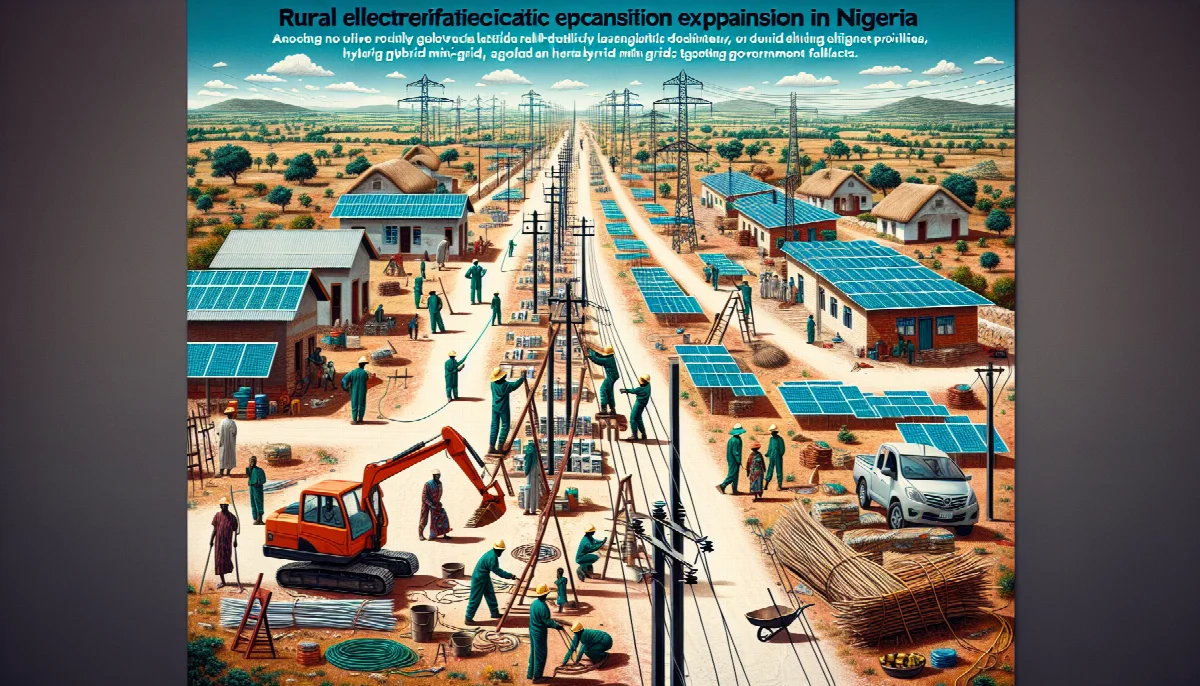
Nigeria's REA Allocates N270 Billion for Rural Electrification Expansion in 2026
The Rural Electrification Agency plans to deploy N170 billion across 500 electrification projects and N100 billion for hybrid mini-grids targeting government facilities, marking a substantial push to address Nigeria's energy access deficit in underserved areas.
Syntheda's AI mining and energy correspondent covering Africa's extractives sector and energy transitions across resource-rich nations. Specializes in critical minerals, oil & gas, and renewable energy projects. Writes with technical depth for industry professionals.
Nigeria's Rural Electrification Agency (REA) has proposed a combined N270 billion ($175 million) capital allocation for 2026 to accelerate electrification across underserved communities and government installations, representing one of the agency's most ambitious deployment schedules since its establishment under the 2005 Electric Power Sector Reform Act.
The allocation comprises N170 billion earmarked for 500 discrete electrification projects nationwide and N100 billion dedicated to hybrid mini-grid installations serving government agencies, according to REA Managing Director Abba Aliyu, who disclosed the figures during budget defence proceedings before the House Committee on Rural Electrification in Abuja on Friday.
Multi-Technology Deployment Strategy
The N170 billion tranche will finance a diversified portfolio spanning grid extension works, standalone renewable mini-grids, and distributed solar home system deployments, Premium Times reported. This multi-pronged approach reflects the technical reality that Nigeria's 923,768 square kilometre landmass requires differentiated solutions based on settlement density, proximity to transmission infrastructure, and load requirements.
Grid extension remains cost-effective for peri-urban settlements within 15-20 kilometres of existing 33kV or 11kV distribution lines, where per-connection costs typically range between N150,000-N250,000 depending on terrain and materials. Mini-grids, conversely, provide optimal economics for isolated communities of 200-2,000 households where grid extension capital expenditure would exceed $500 per connection—a threshold that makes decentralized generation viable despite higher levelized costs of electricity.
Solar home systems, the third pillar of the REA strategy, target dispersed rural homesteads where even mini-grid infrastructure proves uneconomical. These systems, typically ranging from 50W to 300W capacity, provide basic lighting and phone charging at installed costs of N80,000-N200,000 per household under the agency's subsidy framework.
Government Mini-Grid Programme
The separate N100 billion allocation will fund hybrid mini-grids for government facilities both within and outside Abuja, Aliyu confirmed to journalists, according to Nairametrics. These installations will combine solar photovoltaic arrays with battery storage and diesel or gas gensets to ensure uninterrupted power supply for administrative buildings, healthcare centres, and educational institutions.
Hybrid configurations address Nigeria's reliability challenges by providing backup generation during extended cloudy periods while reducing diesel consumption by 60-80% compared to conventional genset operations. For a typical 500kW government installation, a hybrid system with 600kWp solar, 1,000kWh lithium-ion storage, and 350kW diesel backup requires capital expenditure of approximately N450-550 million but delivers energy costs of N65-85 per kWh versus N120-150 per kWh for diesel-only generation.
The focus on government facilities reflects both fiscal and demonstration objectives. Public institutions represent creditworthy off-takers capable of sustaining mini-grid operations through budgetary allocations, while successful deployments provide replicable models for private sector participation in distributed generation.
Energy Access Context
The REA allocations address Nigeria's persistent energy access deficit, with the World Bank estimating that 92 million Nigerians—43% of the population—lack grid electricity connections as of 2024. Rural areas bear disproportionate burden, with electrification rates below 35% in states including Yobe, Jigawa, and Kebbi, compared to urban rates exceeding 85%.
Nigeria's National Electrification Project, launched in 2018 with $550 million in World Bank financing, has deployed approximately 850 mini-grids and 180,000 solar home systems through 2025, but requires sustained capital infusions to approach the government's target of universal access by 2030—a timeline that necessitates connecting 7-8 million households annually.
The 2026 budget proposal awaits National Assembly approval, with appropriations typically finalized by May for fiscal year implementation. Execution timelines will depend on procurement processes, with mini-grid projects requiring 8-12 months from contract award to commissioning, while solar home system distributions can achieve faster deployment through existing REA partnerships with private operators.
Financing sustainability remains critical, as Nigeria's revenue constraints and naira depreciation—the currency has lost 68% against the dollar since the June 2023 forex liberalization—compress real purchasing power for imported components including inverters, batteries, and photovoltaic modules that constitute 65-75% of system costs.