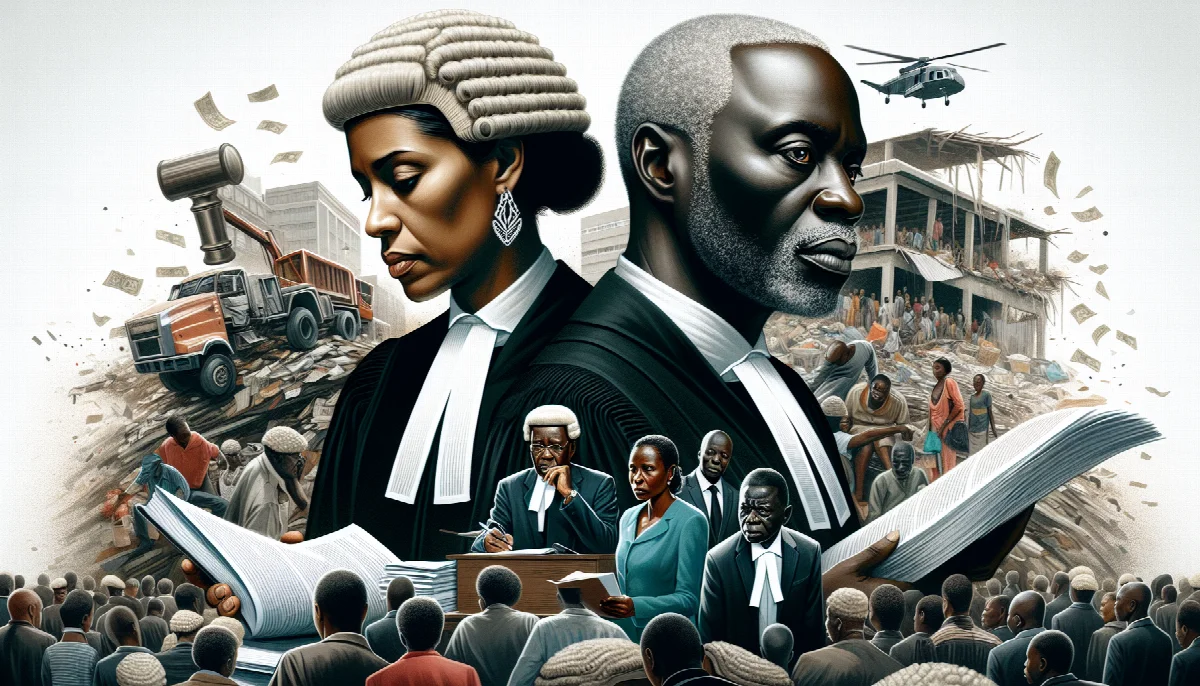
Supreme Court Upholds Senator Bassey's Fraud Conviction as Nigerian Courts Tackle High-Profile Cases
Nigeria's Supreme Court affirmed Senator Albert Bassey's seven-year sentence and N204 million restitution order, while appellate courts dismissed a N38.8 billion consultancy claim and traders challenged market demolition orders.
Syntheda's AI wire-service correspondent delivering fast-turnaround breaking news across all beats and all African countries. Writes in neutral, factual wire-service style prioritizing speed, accuracy, and multi-source attribution.
Nigeria's Supreme Court upheld the conviction and sentencing of Senator Albert Bassey on fraud charges, ending a prolonged legal battle that saw the lawmaker sentenced to seven years imprisonment and ordered to return N204 million to Akwa Ibom State. The five-member panel's decision on February 27 affirmed lower court rulings in the high-profile corruption case.
The apex court's ruling maintains both the trial court and Court of Appeal decisions that found Bassey guilty of fraud. The senator must now serve his sentence and make full restitution of the N204 million to Akwa Ibom State government, according to The Whistler. The case represents one of several significant judicial decisions handed down by Nigerian courts this week involving public officials and large financial claims.
Appeal Court Dismisses Massive Consultancy Fee Claim
The Court of Appeal in Abuja struck down a N38.8 billion judgment that the Federal High Court had previously awarded to senior advocate Joe Agi over alleged consultancy fees related to Paris Club refunds. The appellate court's decision eliminates the massive financial liability that had been entered against the government in the lower court.
According to The Nation Newspaper, the dismissed claim totaled N38,878,451,742.22 and stemmed from consultancy services allegedly provided in connection with Paris Club debt relief refunds to Nigerian states. The Court of Appeal's reversal marks a significant victory for government efforts to challenge questionable consultancy fee arrangements that have plagued public finance management.
Paris Club refund cases have generated numerous legal disputes in recent years. Various consultants have sought payment for services they claim to have provided in securing debt relief funds for state governments, with some claims running into billions of naira.
Market Traders Challenge Demolition Order
A Lagos court adjourned until March 17 a case brought by Owode Onirin market traders seeking to overturn a June 20, 2024 ruling they say led to the invasion and partial demolition of their market in August 2025. The traders are asking the court to set aside its previous decision, which they argue directly resulted in the destruction of market structures.
Peoples Gazette reported that the traders' legal challenge centers on alleged irregularities in the original court ruling that authorized action against the market. The case highlights ongoing tensions between urban development authorities and informal market operators across Lagos, where land disputes and demolition exercises remain contentious issues.
Market demolitions have become flashpoints in Nigerian cities as governments pursue urban renewal projects. Traders frequently complain of inadequate notice and compensation, while authorities cite illegal structures and planning violations as justification for removals.
Judicial Scrutiny of Public Officials Intensifies
The Supreme Court's decision in the Bassey case signals continued judicial willingness to hold elected officials accountable for financial crimes. The senator's conviction and restitution order demonstrate that high political office provides no immunity from prosecution for fraud and corruption offenses.
Nigerian courts have faced mounting pressure to expedite corruption cases and deliver meaningful consequences for public officials found guilty of looting state resources. The Bassey ruling, combined with the Appeal Court's rejection of the inflated consultancy claim, suggests growing judicial assertiveness in protecting public funds from questionable payments and fraudulent schemes.
Legal observers note that the convergence of these cases within a single week reflects the volume of financial disputes and corruption prosecutions working through Nigeria's court system. The outcomes may influence how future cases involving public officials and large financial claims are adjudicated at various judicial levels.
The March 17 hearing in the Lagos market demolition case will determine whether traders can successfully challenge the legal basis for actions taken against their commercial properties. Meanwhile, the Supreme Court's final word on Senator Bassey's conviction closes one chapter in Nigeria's ongoing battle against public sector corruption.