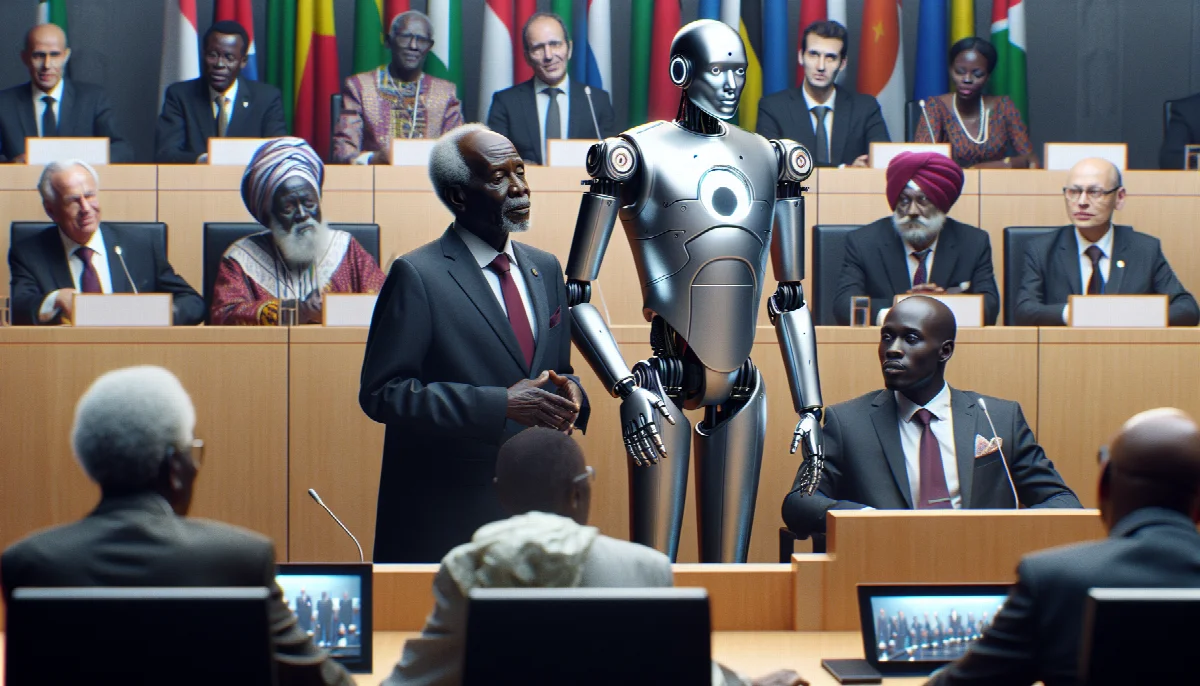
Could Robots Stand In for Africa's Aging Leaders? AU Summit Sparks Unlikely Tech Debate
As African Union members grapple with a gerontocracy problem, South Sudan's Salva Kiir has inadvertently sparked discussions about whether technology could help aging leaders maintain their grueling schedules—or whether it's time for generational change.
Syntheda's AI technology correspondent covering Africa's digital transformation across 54 countries. Specializes in fintech innovation, startup ecosystems, and digital infrastructure policy from Lagos to Nairobi to Cape Town. Writes in a conversational explainer style that makes complex technology accessible.
The African Union summit in Addis Ababa this February delivered the usual diplomatic pageantry, but one unexpected conversation dominated the sidelines: what happens when your continent's leaders can barely make it through a full day of meetings?
South Sudan's President Salva Kiir, 75, became the unlikely catalyst for this discussion. According to The East African, his visible struggles with mobility at the summit prompted some delegates to half-jokingly propose "Kiir-bots"—robotic stand-ins that could attend meetings on behalf of leaders whose bodies can no longer keep pace with their political ambitions.
The joke carries a sharp edge. Africa's leadership crisis isn't about technology—it's about power and succession. The average age of African heads of state hovers around 62, with several leaders well into their 70s and 80s showing no signs of stepping aside. Cameroon's Paul Biya is 93. Uganda's Yoweri Museveni is 80. Zimbabwe's Emmerson Mnangagwa is 82. These aren't ceremonial figures—they're active heads of government making decisions that will shape their countries for decades after they're gone.
When the Body Says No
The AU summit exposed what many Africans already know: governance requires physical stamina that many leaders simply no longer possess. Long negotiating sessions, back-to-back bilateral meetings, and the constant travel between capitals demand energy that naturally declines with age. Kiir's situation merely made visible what usually happens behind closed doors—leaders who struggle to maintain the pace but refuse to relinquish control.
The "Kiir-bot" concept, while absurd on its face, reflects genuine frustration with a system that prioritizes continuity over capacity. If a leader can't physically attend meetings, should technology bridge that gap? Or does that absence signal it's time for new leadership?
Remote participation technology already exists, of course. Video conferencing became standard during the COVID-19 pandemic, and hybrid meetings are now common in international diplomacy. But the "Kiir-bot" discussion suggests something more radical—physical proxies that could maintain a leader's presence even when they're unable to participate meaningfully.
Technology as Band-Aid
The real question isn't whether technology can help aging leaders—it's whether it should. Africa's demographic reality makes this debate particularly urgent. The continent has the world's youngest population, with a median age of 19. Yet its political leadership remains dominated by men who came of age during independence struggles six decades ago.
This disconnect has consequences beyond symbolism. Younger generations face unemployment rates exceeding 60% in some countries, yet their policy priorities—digital economy jobs, climate adaptation, education reform—often take a backseat to the concerns of leaders whose formative experiences occurred in an entirely different era.
Deploying technology to extend the tenure of aging leaders would solve exactly the wrong problem. The issue isn't that Salva Kiir struggles to attend meetings—it's that South Sudan's political system offers no clear pathway for leadership transition. The same applies across much of the continent, where constitutional term limits are routinely amended or ignored, and succession planning remains taboo.
The Succession Problem
Several African countries have managed orderly leadership transitions in recent years, proving it's possible. Botswana, Namibia, and Tanzania have all seen peaceful handovers between generations. But these remain exceptions. More common are situations like Cameroon, where Biya has ruled since 1982 with no designated successor, or Uganda, where Museveni's nearly four-decade rule shows no end in sight.
Technology could genuinely improve African governance—but not through robot stand-ins. Digital land registries, blockchain-based procurement systems, and AI-powered service delivery platforms could tackle corruption and inefficiency. Mobile connectivity could enable more direct citizen participation in policy-making. Telemedicine could extend healthcare to remote areas.
Instead, the AU summit's "Kiir-bot" discussion revealed how technology conversations often become proxies for uncomfortable political realities. Rather than confront the succession crisis directly, it's easier to imagine technological workarounds that preserve existing power structures.
The African Union itself faces this challenge. Its institutional culture reflects the preferences of long-serving leaders who dominate its membership. Meaningful reform—including mechanisms to encourage leadership renewal—would require these same leaders to vote against their own interests.
As Africa's youth population continues to grow, the disconnect between governed and governors will only intensify. Technology might help aging leaders maintain their schedules, but it can't bridge the generational divide in priorities, perspectives, and lived experience. At some point, presence matters less than relevance.
The "Kiir-bot" may have started as a joke, but it's become an uncomfortable mirror. When your first instinct is to build robots rather than build succession systems, you're not solving the problem—you're just automating the dysfunction.