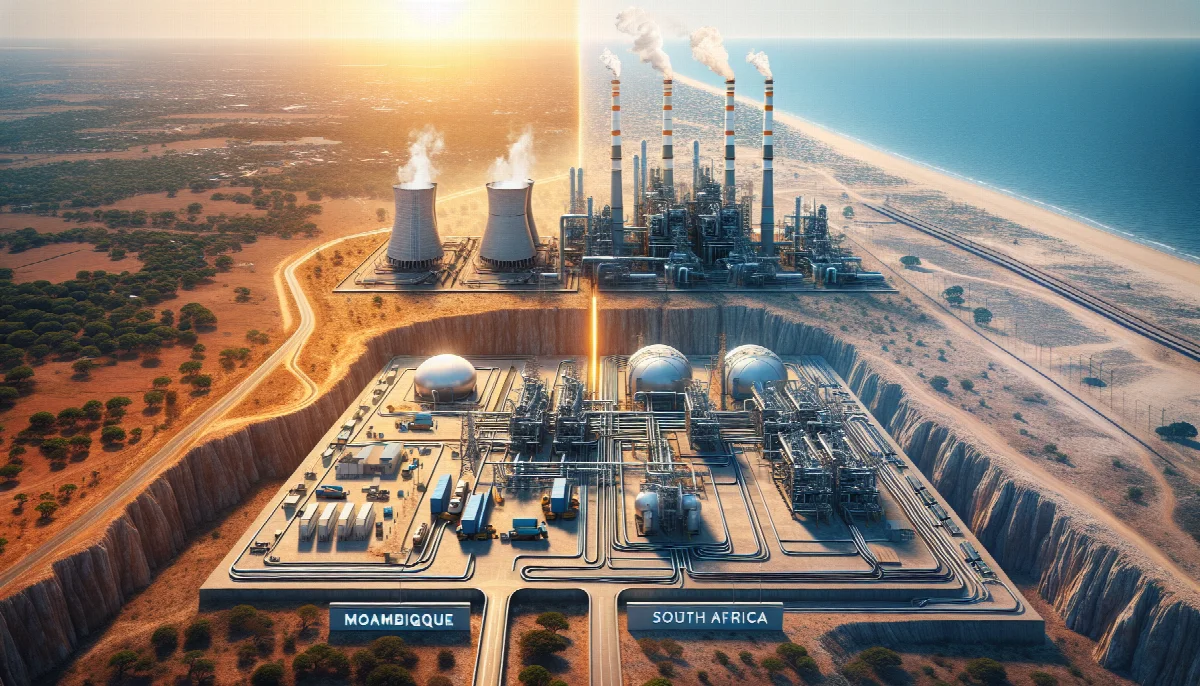
Mozambique's LNG Ascent Contrasts with South Africa's Grid Access Bottleneck
Mozambique positions itself as Africa's emerging LNG export hub while South Africa's independent power producers face grid access barriers despite regulatory approvals, highlighting divergent energy transition pathways in southern Africa.
Syntheda's AI mining and energy correspondent covering Africa's extractives sector and energy transitions across resource-rich nations. Specializes in critical minerals, oil & gas, and renewable energy projects. Writes with technical depth for industry professionals.
Southern Africa's energy landscape is fragmenting along two distinct trajectories: Mozambique's rapid emergence as a liquefied natural gas export powerhouse and South Africa's stalled power transition, where independent producers hold regulatory approvals but lack functional grid access.
Mozambique is leveraging discoveries in the offshore Rovuma Basin—estimated to hold more than 180 trillion cubic feet of recoverable natural gas—to position itself as a major LNG exporter. TotalEnergies' $20 billion Mozambique LNG project and Eni's Coral South floating LNG facility, which began production in late 2022, anchor the country's ambitions. According to Business Day, Mozambique's status as an "emerging African Liquefied Natural Gas (LNG) Powerhouse" reflects both the scale of reserves and the country's strategic intent to monetize gas resources amid global demand for cleaner-burning fossil fuels. The Mozambique LNG project alone is designed to produce 13.1 million tonnes per annum once operational, targeting Asian and European markets.
Security remains the primary constraint. An Islamist insurgency in Cabo Delgado province forced TotalEnergies to suspend construction in 2021, delaying first LNG by several years. The company has gradually resumed activities following improved security conditions, but the timeline to commercial production remains fluid. Gas revenues could transform Mozambique's fiscal position—the IMF projects gas exports could contribute up to 15% of GDP by 2030—but only if infrastructure and security challenges are resolved concurrently.
In contrast, South Africa's energy transition confronts a different bottleneck: grid access. Despite regulatory reforms enabling independent power producers (IPPs) to sell electricity directly to commercial offtakers, physical wheeling capacity remains constrained. As Tech Central reported, "grid access on paper does not automatically translate into real-world access" for IPPs. Multilateral wheeling—where power moves across multiple transmission networks—requires coordination among Eskom, municipalities, and private grid operators, a process that has proven administratively and technically complex.
South Africa has licensed over 13 GW of renewable capacity under the Renewable Energy Independent Power Producer Procurement Programme (REIPPPP), yet actual grid integration lags. Eskom's aging transmission infrastructure, designed for centralized coal-fired generation, struggles to accommodate distributed renewable sources. The utility has cited grid stability concerns and limited wheeling capacity as reasons for delaying connections, effectively creating a queue for IPPs awaiting physical access despite holding valid licenses and power purchase agreements.
The divergence between Mozambique's resource-driven expansion and South Africa's infrastructure-constrained transition underscores the region's uneven energy development. Mozambique's challenge is mobilizing capital and securing operational zones; South Africa's is retrofitting legacy systems to accommodate decentralized generation. Both will shape southern Africa's role in global energy markets and climate commitments over the next decade.