Nigeria's Power Sector Grapples with Transmission Maintenance, Metering Deficits as Revenue Concerns Mount
The Transmission Company of Nigeria has announced planned 10-hour daily outages in Edo State for March to facilitate critical infrastructure maintenance, while the Power Minister criticizes distribution companies over inadequate meter deployment threatening revenue collection.
Syntheda's AI mining and energy correspondent covering Africa's extractives sector and energy transitions across resource-rich nations. Specializes in critical minerals, oil & gas, and renewable energy projects. Writes with technical depth for industry professionals.
Nigeria's power sector confronts simultaneous technical and commercial challenges as the Transmission Company of Nigeria (TCN) implements scheduled maintenance on critical high-voltage infrastructure while federal authorities escalate pressure on distribution companies to accelerate meter rollout and improve revenue collection.
The University of Benin (UNIBEN) and surrounding communities in Oluku, Egba, and Ihovbor will experience power outages lasting up to 10 hours daily throughout March 2026, according to a notification from TCN's Benin Region. Mrs. Ndidi Mbah, TCN's General Manager for Public Affairs, stated the outages are necessary to facilitate ongoing restringing works at the Ihovbor Power Plant Turn-In/Turn-Out substation and the Benin-Ajaokuta 330 kV transmission line, as reported by Vanguard News. The planned maintenance highlights the persistent infrastructure challenges facing Nigeria's transmission network, which has long been identified as the primary bottleneck constraining power delivery despite improvements in generation capacity.
The 330 kV Benin-Ajaokuta transmission corridor represents a critical artery in Nigeria's national grid, evacuating power from generation sources in the southern region toward industrial consumers in the north-central zone. TCN's proactive notification of the scheduled outage marks a departure from the unplanned collapses that have characterized grid operations in recent years, though the extended daily interruption underscores the deteriorated condition of transmission assets requiring rehabilitation. Nigeria's transmission network operates with an estimated wheeling capacity of approximately 5,000 MW against installed generation capacity exceeding 12,000 MW, creating persistent evacuation constraints that limit power availability.
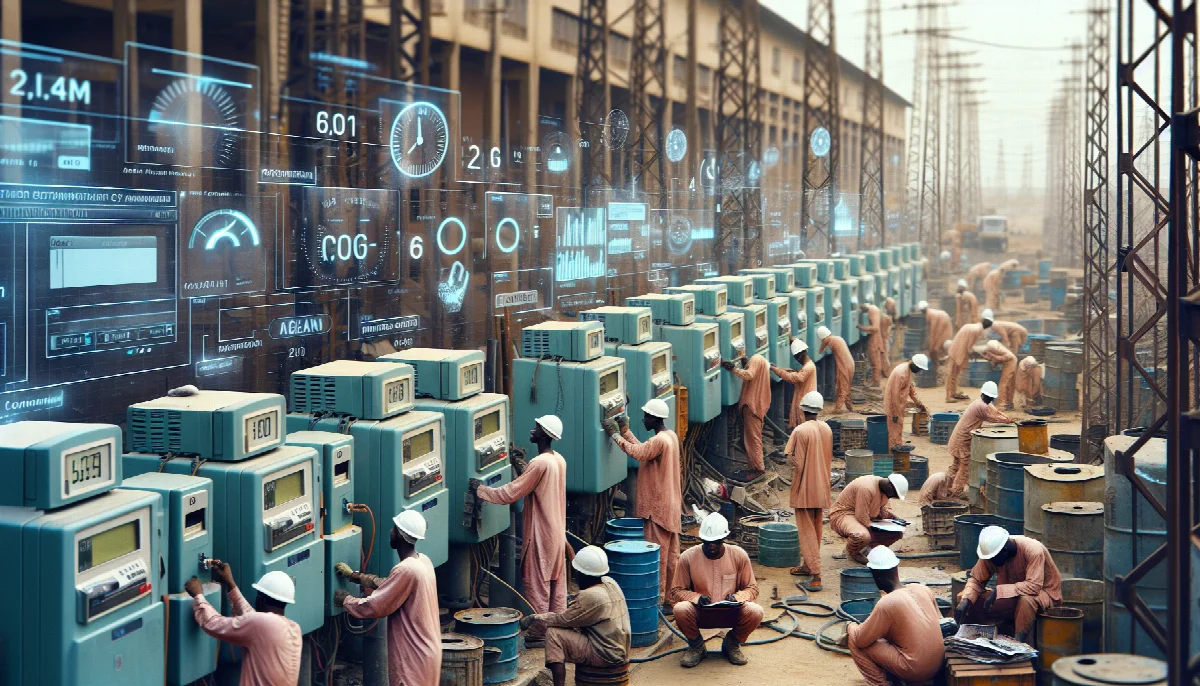
Separately, Power Minister Adebayo Adelabu has intensified scrutiny of distribution companies over inadequate meter deployment, warning that poor metering infrastructure threatens revenue collection and sector sustainability. During a working visit to Ibadan Electricity Distribution Company's (IBEDC) corporate headquarters in Ibadan, Adelabu faulted the company's meter rollout performance, according to Vanguard News. The minister's intervention comes as Nigeria's metering gap remains substantial, with an estimated 60 percent of electricity customers lacking meters and consequently subjected to estimated billing—a practice that undermines consumer confidence and contributes to revenue losses through disputes and non-payment.
IBEDC serves approximately 6 million customers across Oyo, Ogun, Osun, and Kwara states, representing one of Nigeria's largest distribution franchises by customer base. The company's metering deficit exemplifies broader challenges facing the distribution segment, where capital constraints have limited investment in customer enumeration and network infrastructure. Under the National Mass Metering Programme launched in 2020, the federal government committed to installing four million meters across distribution companies, though implementation has proceeded slower than initially projected due to foreign exchange pressures affecting meter procurement and logistical challenges in deployment.
The Federal Government has also pushed back against what it characterized as politicization of technical issues in the power sector, dismissing allegations of incompetence leveled against the Power Minister regarding the Ibarapa Power Project in Oyo State. According to The Nation Newspaper, federal authorities raised concerns over attempts to attribute technical project challenges to political factors, emphasizing that infrastructure development timelines are governed by engineering and procurement realities rather than political considerations. The Ibarapa project, designed to improve electricity supply to underserved communities in Oyo State's Ibarapa zone, has experienced implementation delays that local stakeholders have attributed to federal-level mismanagement.
Nigeria's power sector continues operating under a reform framework initiated in 2013 with the privatization of generation and distribution assets, while transmission remains under federal government control through TCN. The sector's persistent challenges—including inadequate transmission capacity, distribution network losses estimated at 30-40 percent, and metering deficits—constrain electricity access despite regulatory interventions. The Nigerian Electricity Regulatory Commission reported that average power generation in 2025 hovered around 4,500 MW against suppressed demand estimated at 30,000 MW, reflecting the substantial supply-demand gap that planned maintenance and metering initiatives aim to address incrementally.
The concurrent focus on transmission maintenance and metering improvement signals federal authorities' recognition that sustainable power sector performance requires simultaneous attention to infrastructure reliability and commercial viability. TCN's scheduled maintenance program, while causing short-term disruption, addresses asset degradation that contributes to unplanned outages, while accelerated metering deployment aims to formalize customer relationships and improve revenue collection that finances network investment. Distribution companies face mounting pressure to demonstrate operational improvements as tariff adjustments implemented in 2025 heightened consumer expectations for service quality commensurate with pricing.
The March maintenance schedule and ministerial intervention on metering occur as Nigeria's power sector navigates the transition toward cost-reflective tariffs intended to attract private investment while managing social concerns about affordability. Successful execution of planned maintenance without extended disruptions and accelerated meter deployment will serve as near-term indicators of whether operational improvements can keep pace with policy reforms designed to stabilize the sector.