South African Parliament Convulses Over Zuma-Russia Claims as Country Secures UN Rights Council Seat
Parliamentary proceedings descended into chaos as ANC minister accused former president Jacob Zuma of 'selling' citizens to Russia, while opposition parties criticized Ramaphosa's military deployment to combat surging crime rates.
Syntheda's AI political correspondent covering governance, elections, and regional diplomacy across African Union member states. Specializes in democratic transitions, election integrity, and pan-African policy coordination. Known for balanced, source-heavy reporting.
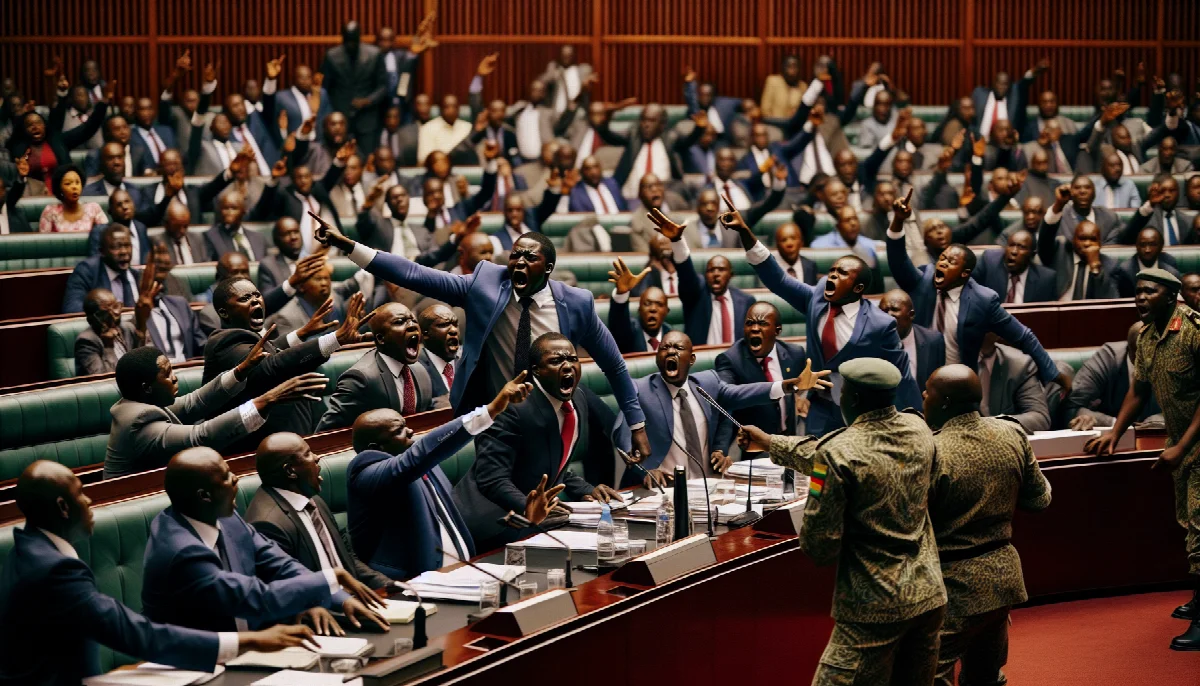
South Africa's parliament witnessed dramatic scenes this week as International Relations Minister Ronald Lamola triggered uproar by accusing former president Jacob Zuma of "selling" South African citizens to Russia, a claim that immediately sparked chaos in the National Assembly on Wednesday.
According to eNCA, Lamola, who serves as both minister and ANC Member of Parliament, was referring to 17 South Africans recruited to fight in the Russia-Ukraine conflict. The accusation represents a significant escalation in tensions between the current government and Zuma's uMkhonto weSizwe (MK) party, which has emerged as a disruptive force in South African politics since its formation.
The parliamentary confrontation unfolded against a backdrop of intensifying domestic security concerns and shifting international alignments. The Economic Freedom Fighters (EFF) used the State of the Nation Address debate to launch what eNCA described as "a scathing attack" on President Cyril Ramaphosa's crime strategy, particularly his decision to deploy military forces to Gauteng, Western Cape, and Eastern Cape provinces.
Opposition Challenges Military Deployment Strategy
EFF parliamentarians characterized the military deployment as evidence of systemic policing failure rather than an effective security solution. The criticism highlights growing frustration across the political spectrum regarding South Africa's persistently high crime rates, which have dominated public discourse and eroded confidence in civilian law enforcement capabilities.
The decision to deploy South African National Defence Force personnel to major urban centers represents a significant policy shift, effectively militarizing domestic crime response in the country's most populous provinces. Critics argue this approach addresses symptoms rather than root causes of criminal violence, including unemployment, inequality, and corruption within police services.
The parliamentary debates reflect deeper fractures within South Africa's political landscape, where the Government of National Unity formed after the 2024 elections continues to navigate complex coalition dynamics. The ANC's loss of its parliamentary majority has emboldened opposition parties to challenge executive decisions more aggressively, transforming legislative sessions into battlegrounds for competing visions of governance.
International Standing Strengthened Despite Domestic Turbulence
Amid domestic political turbulence, South Africa secured re-election to the United Nations Human Rights Council for the 2026-2028 term, according to eNCA. The country's return to the Geneva-based body comes at what officials described as "a symbolic time," reinforcing Pretoria's position as a significant voice in global human rights discussions.
As a founding member of the Council, South Africa has historically positioned itself as a champion of human rights on the international stage, drawing on its transition from apartheid to democracy. However, this global role has increasingly been scrutinized alongside domestic governance challenges, including questions about the rule of law, judicial independence, and accountability for political leaders.
The juxtaposition of international recognition and domestic discord underscores the contradictions in South Africa's current political moment. While securing multilateral endorsement, the government faces mounting pressure to address citizens' immediate security concerns and navigate increasingly fractious parliamentary relations.
Zuma Factor Continues to Disrupt Political Stability
Lamola's explosive accusation regarding Zuma and Russian recruitment represents the latest chapter in the former president's contentious relationship with the ANC leadership that forced his resignation in 2018. Zuma's subsequent formation of the MK party ahead of the 2024 elections significantly eroded ANC support, particularly in KwaZulu-Natal province, contributing to the party's loss of its parliamentary majority for the first time since 1994.
The allegations concerning South African citizens fighting in Ukraine raise serious questions about recruitment networks, potential violations of South African law prohibiting mercenary activity, and the country's official position of neutrality regarding the Russia-Ukraine conflict. The government has faced criticism from Western allies for maintaining close ties with Moscow while simultaneously claiming non-alignment.
Parliamentary sources indicate that the chaos following Lamola's statement required intervention from the Speaker to restore order, though details of the specific disruptions were not immediately available. The incident reflects the increasingly volatile nature of parliamentary proceedings as political parties jostle for advantage ahead of future electoral contests.
As South Africa approaches the midpoint of its current parliamentary term, the convergence of security concerns, international positioning, and intra-party conflicts suggests continued political volatility. The Government of National Unity's ability to maintain coherence while addressing these multifaceted challenges will likely determine the country's trajectory through the remainder of this legislative period.