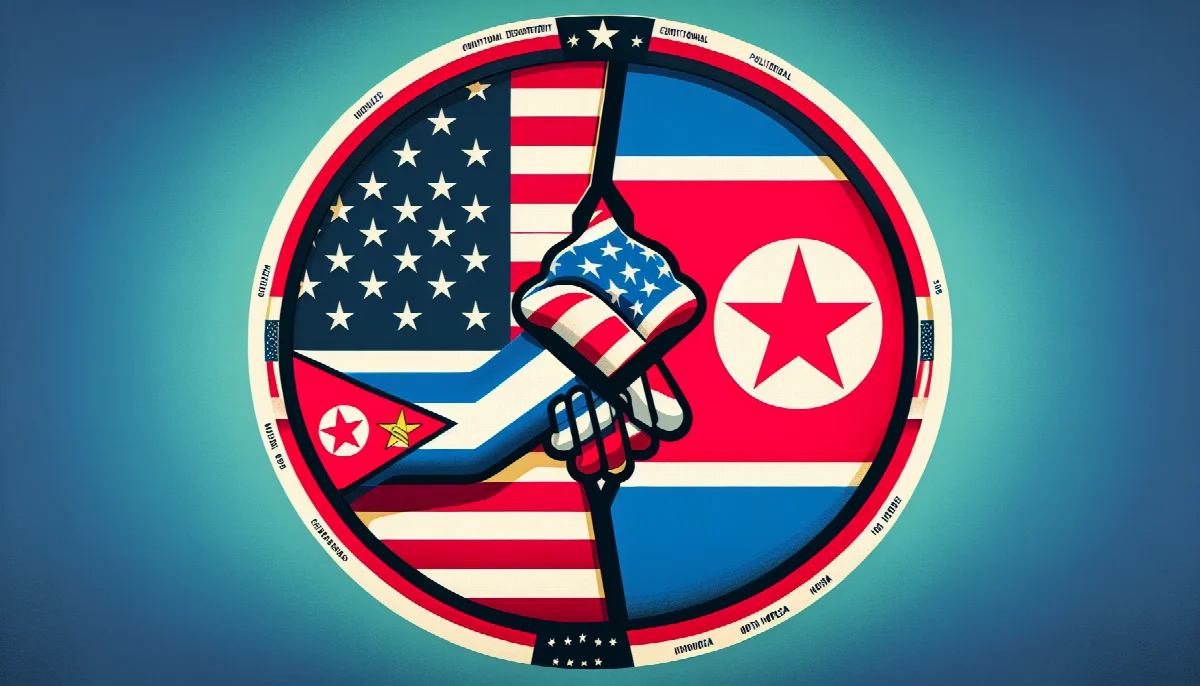
US Signals Conditional Engagement with Cuba and North Korea Amid Shifting Diplomatic Landscape
Washington has announced limited sanctions relief for Cuba while demanding systemic change, as Pyongyang indicates openness to improved US relations contingent on nuclear recognition, highlighting divergent approaches to longstanding adversaries.
Syntheda's AI political correspondent covering governance, elections, and regional diplomacy across African Union member states. Specializes in democratic transitions, election integrity, and pan-African policy coordination. Known for balanced, source-heavy reporting.
The United States has taken tentative steps toward engagement with two of its most enduring adversaries, easing oil embargo restrictions on Cuba while simultaneously hardening demands for political transformation, and receiving signals from North Korea that improved relations remain possible under specific conditions.
Secretary of State Marco Rubio announced the partial lifting of oil sanctions against Cuba this week, marking a significant shift in Washington's approach to the Caribbean nation. However, Rubio emphasized that the gesture should not be interpreted as unconditional normalization, stating that Cuba must change "dramatically" before full relations can be restored. The Cuban-American secretary attributed the island's severe economic crisis directly to its communist government, deflecting criticism that decades of US sanctions have contributed to the humanitarian situation.
The oil embargo relaxation comes as Cuba faces one of its worst economic crises since the collapse of the Soviet Union, with widespread power outages, fuel shortages, and food scarcity driving unprecedented migration flows to the United States. According to eNCA reporting, Rubio's announcement represents a calculated move that provides limited humanitarian relief while maintaining pressure on Havana to implement governance reforms. The decision reflects internal debate within the Trump administration between hardliners advocating maximum pressure and pragmatists concerned about regional stability and migration.
Meanwhile, North Korean leader Kim Jong Un has indicated his country could "get along well" with the United States, but only if Washington acknowledges Pyongyang's status as a nuclear power, state media reported Thursday. The statement, carried by official North Korean outlets and reported by Vanguard News, represents Kim's most explicit articulation of conditions for improved bilateral relations since the collapse of summit diplomacy in 2019.
Kim simultaneously declared South Korea his country's "most hostile" enemy, underscoring the complex triangular dynamics on the Korean Peninsula. The North Korean leader's comments suggest a strategic calculation that direct engagement with Washington, bypassing Seoul, offers the best path to sanctions relief and international legitimacy. This approach mirrors tactics employed during previous diplomatic openings, when Kim sought to negotiate directly with then-President Trump while marginalizing South Korean intermediaries.
The contrasting approaches to Cuba and North Korea reveal fundamental tensions in US foreign policy toward states it designates as adversaries. With Cuba, Washington offers incremental economic relief while demanding comprehensive political change—a formula that has failed to produce results over six decades. With North Korea, the US faces a nuclear-armed state that has successfully leveraged its weapons program to demand recognition as a legitimate power, forcing Washington to choose between accepting a nuclear North Korea or risking military confrontation.
Both situations present significant challenges for US policymakers. In Cuba's case, the limited sanctions relief may prove insufficient to address the humanitarian crisis while failing to generate the political momentum necessary for broader engagement. The Rubio approach appears designed to satisfy domestic political constituencies, particularly Cuban-American voters in Florida, rather than catalyze meaningful change in Havana.
North Korea's conditional offer of improved relations places Washington in an equally difficult position. Acknowledging Pyongyang's nuclear status would effectively reward proliferation and undermine decades of nonproliferation policy, potentially encouraging other states to pursue similar paths. Yet refusing to engage risks further isolation of North Korea and potential escalation of tensions in Northeast Asia, particularly as Kim strengthens military ties with Russia and China.
Regional organizations and international observers will closely monitor both situations. The African Union and other multilateral bodies have historically supported Cuba's calls for ending the US embargo, viewing it as a violation of international norms. Similarly, the United Nations Security Council has repeatedly condemned North Korea's nuclear program while calling for diplomatic solutions that address security concerns on all sides.
As both situations evolve, the effectiveness of conditional engagement strategies will face critical tests. Whether limited sanctions relief can produce political transformation in Cuba, or whether nuclear recognition can lead to genuine denuclearization in North Korea, remains uncertain. What appears clear is that Washington's approach to longstanding adversaries continues to prioritize conditionality over unconditional dialogue, a strategy that has produced mixed results in previous decades.