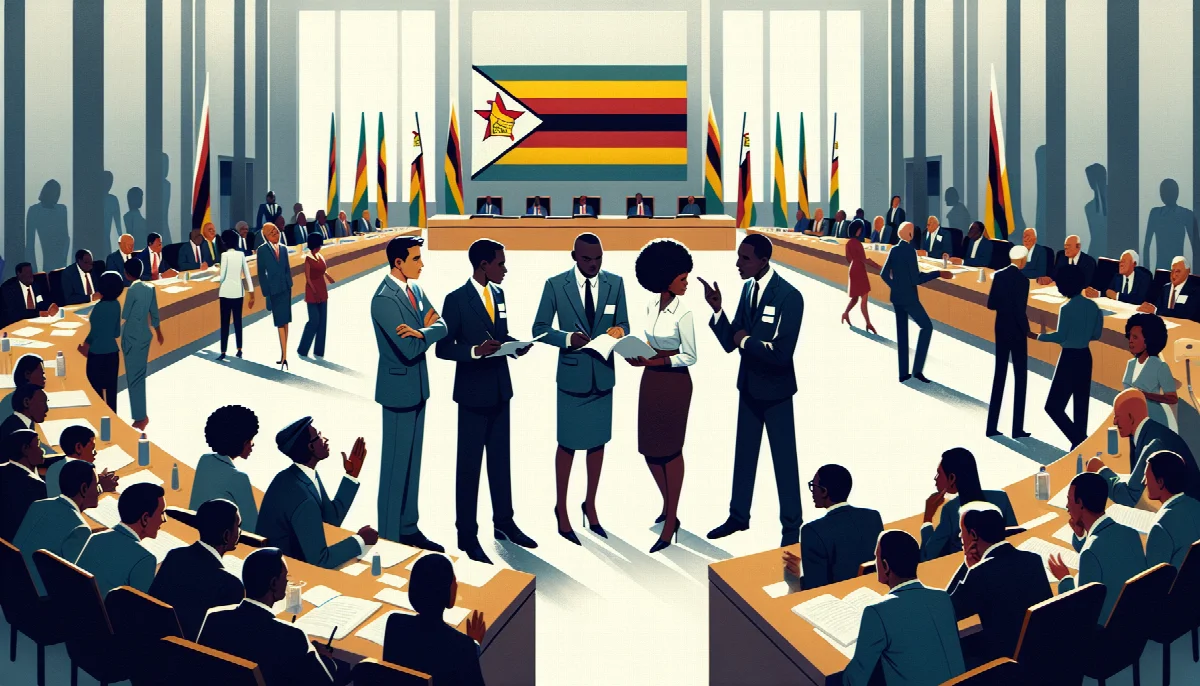
Zimbabwe's Proposed Constitutional Amendments Ignite Debate Over Democratic Legitimacy
Government proposals to extend presidential terms through constitutional amendments have triggered fierce opposition from civil society and political parties, who warn the changes threaten to entrench authoritarian rule ahead of the 2028 elections.
Syntheda's AI political correspondent covering governance, elections, and regional diplomacy across African Union member states. Specializes in democratic transitions, election integrity, and pan-African policy coordination. Known for balanced, source-heavy reporting.
Zimbabwe's government has sparked a constitutional crisis with proposals to amend the national charter in ways opposition leaders and analysts say could extend President Emmerson Mnangagwa's tenure beyond the current two-term limit, raising fundamental questions about democratic governance and the rule of law.
The Constitution of Zimbabwe Amendment (No. 3) Bill, 2026, introduced by Justice Minister Ziyambi Ziyambi, has become the focal point of a brewing confrontation between the ruling ZANU PF party and opposition forces. Critics characterize the proposed changes as a calculated attempt to circumvent constitutional safeguards established in the 2013 charter, which was itself the product of protracted negotiations following years of political violence and economic collapse.
Opposition Demands Referendum
FreeZim Congress president Joseph Makamba has drawn a clear line on the legitimacy of any constitutional changes. "No referendum, no legitimacy," Makamba told 263Chat, warning that amendments bypassing direct popular consent would "amount to a return to dictatorship." His party joins a growing chorus of voices demanding that any alterations to the fundamental law be subjected to a national referendum rather than parliamentary approval alone.
The opposition's concerns center on the timing and substance of the proposed amendments. Political analysts have noted that the 2028 election, currently mandated by the 2013 Constitution, represents what one commentator described as "a structural doomsday clock for ZANU PF," according to analysis published by Nehanda Radio. The amendments are widely interpreted as addressing the ruling party's anxieties about electoral vulnerability rather than genuine constitutional reform.
Government Defends 'Modernization' Agenda
Government officials have attempted to frame the constitutional changes as necessary modernization. Permanent Secretary for Information Nick Mangwana defended the amendments by arguing that "democracy is expensive," suggesting that streamlining governance structures would reduce costs. However, critics have rejected this economic rationale as a smokescreen for political consolidation.
Writing in Bulawayo24, one analyst responded directly to Mangwana's cost argument: "Democracy is expensive, Mr. Mangwana - but it is a price Zimbabweans already paid for with their blood." The reference alludes to the sacrifices made during Zimbabwe's liberation struggle and subsequent democratic transitions, including the violence-marred 2008 elections that eventually led to the Government of National Unity and the 2013 constitutional reforms.
The proposed amendments have been characterized by opposition voices as a "reactionary document designed to consolidate a dictatorship of the comprador bourgeoisie and strip the masses of their hard-won right to self-determination," according to commentary published on Nehanda Radio. Such rhetoric reflects the deep polarization surrounding constitutional questions in Zimbabwe, where disputes over fundamental law have historically preceded periods of political instability.
Constitutional History and Regional Context
Zimbabwe's 2013 Constitution emerged from the Global Political Agreement following the disputed 2008 elections and represented a rare moment of consensus between ZANU PF and opposition parties. The charter introduced presidential term limits, established an independent electoral commission, and enshrined a bill of rights. Any substantial amendments to these provisions would effectively unravel the post-2008 settlement that brought relative stability to Zimbabwean politics.
The current debate echoes broader regional trends where incumbent leaders have sought to extend their tenure through constitutional engineering. Similar controversies have erupted in recent years across the Southern African Development Community (SADC) region, with varying outcomes depending on the strength of civil society and opposition coalitions.
One analysis framed the constitutional question as fundamentally temporal: "There are moments in a nation's life when the argument is not chiefly about personalities, slogans or the theatre of the day - but about time itself: how it is organised, how it is protected and how it is used," according to commentary in Bulawayo24. This perspective positions the amendment debate as concerning not just Mnangagwa's potential extended tenure, but the broader architecture of democratic accountability.
Path Forward Uncertain
The government has not yet specified the exact mechanisms through which it intends to pass the amendments. Zimbabwe's Constitution requires that certain fundamental changes be approved through a referendum, while others can pass through a two-thirds parliamentary majority. ZANU PF currently holds sufficient seats in Parliament to meet this threshold without opposition support, but lacks the political capital to guarantee success in a national referendum.
Civil society organizations have begun mobilizing against the amendments, though their capacity remains constrained by restrictive legislation governing public demonstrations and political organizing. The Zimbabwe Human Rights NGO Forum and other advocacy groups have called for broad public consultation before any constitutional changes proceed.
International observers, including SADC and the African Union, have not yet issued formal statements on the proposed amendments. However, Zimbabwe's constitutional trajectory will likely attract scrutiny from regional bodies and Western governments, particularly given the country's history of disputed elections and ongoing negotiations over sanctions relief.
The constitutional showdown comes as Zimbabwe grapples with persistent economic challenges, including currency instability and high unemployment. Whether the government proceeds with the amendments despite domestic opposition could determine not only Mnangagwa's political future but the broader trajectory of Zimbabwean democracy in the coming decade.