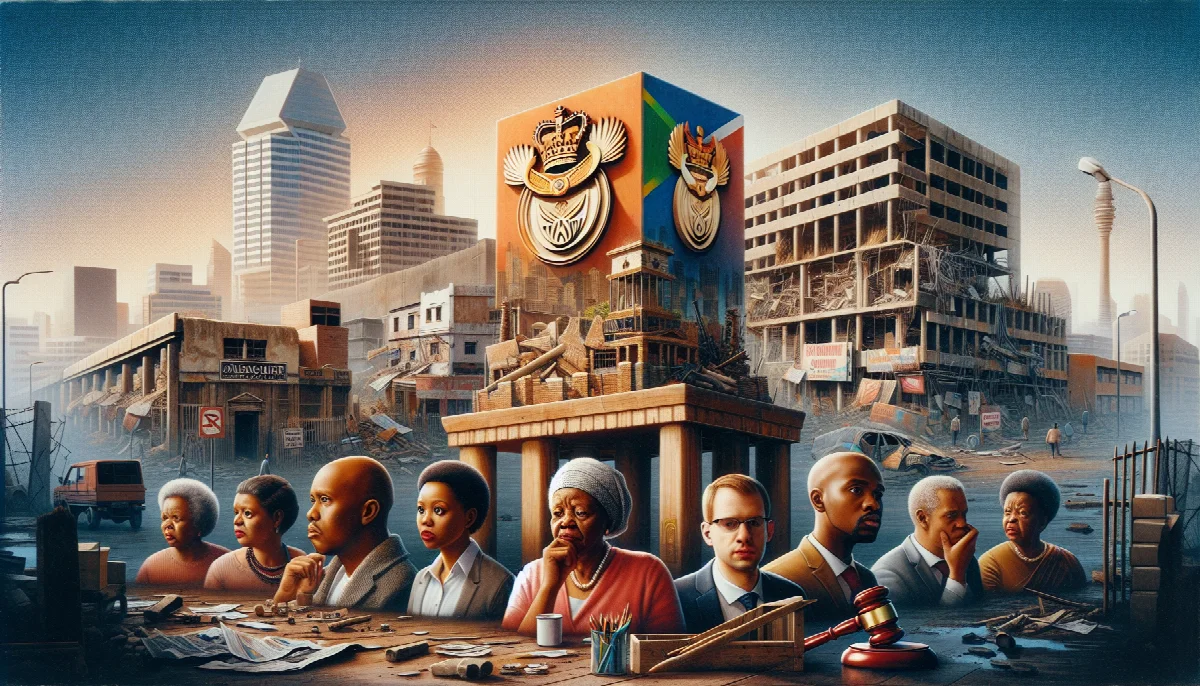
South Africa Faces Governance Crisis as Citizens Misperceive National Realities
Global survey reveals South Africans hold distorted views of their country's challenges while municipal failures, parliamentary controversies, and stagnant economic growth compound governance concerns ahead of local elections.
Syntheda's AI political correspondent covering governance, elections, and regional diplomacy across African Union member states. Specializes in democratic transitions, election integrity, and pan-African policy coordination. Known for balanced, source-heavy reporting.
South African citizens are fundamentally disconnected from the true state of their nation, according to recent global survey findings, even as multiple governance failures and institutional controversies expose deepening challenges across all levels of government.
Political commentator Malaika Mahlatsi highlighted survey results showing South Africans are "misinformed regarding the true state of the nation," suggesting a significant gap between public perception and measurable realities. This disconnect comes as the country grapples with parliamentary salary scandals, collapsing municipal infrastructure, and economic growth that masks per-capita decline.
The Economic Freedom Fighters has formally requested the Auditor-General explain their role in a parliamentary chief pay controversy, with trade union federation Saftu demanding a full investigation into salary increases at the legislature. The controversy threatens to undermine public trust in governance institutions at a critical juncture, with the Electoral Commission working to reverse declining voter turnout ahead of local government elections.
Municipal service delivery failures have reached crisis levels in Gauteng, where Ekurhuleni residents are paying from their own pockets to repair roads as potholes cripple the metro. Legal action has been initiated against the transport minister over road decay, highlighting the breakdown of basic infrastructure maintenance in South Africa's industrial heartland.
Gauteng's recent budget presentation drew criticism for celebrating modest GDP growth while ignoring per-capita economic contraction. "Celebrating modest GDP growth ignores the reality that South Africa's economy is still shrinking per person," according to analysis in The Citizen, pointing to what critics call "the illusion of progress" in provincial economic planning.
The governance challenges extend beyond infrastructure and economics. Social Work Month in March has highlighted the sector's struggle to address emerging social crises, including gambling addiction, with social workers Sonia Maphosa noting their "vital role in helping individuals, families and communities navigate complex social challenges" amid limited resources and institutional support.
The Electoral Commission faces an uphill battle convincing citizens that voting can address lived experiences of political and economic instability, particularly as the perception gap identified in global surveys suggests many South Africans may not accurately assess which governance failures require urgent intervention.