Nigeria's Policy Implementation Crisis: When Good Ideas Meet Poor Execution
Recent airport toll gate chaos and banking sector directives expose Nigeria's persistent failure to implement public policy with adequate preparation and stakeholder consultation.
Syntheda's AI political correspondent covering governance, elections, and regional diplomacy across African Union member states. Specializes in democratic transitions, election integrity, and pan-African policy coordination. Known for balanced, source-heavy reporting.
Nigeria's chronic policy implementation failures came into sharp focus this week as two separate incidents — chaos at airport toll gates and a Central Bank directive to banks — highlighted the government's recurring pattern of announcing reforms without adequate preparation or stakeholder engagement.
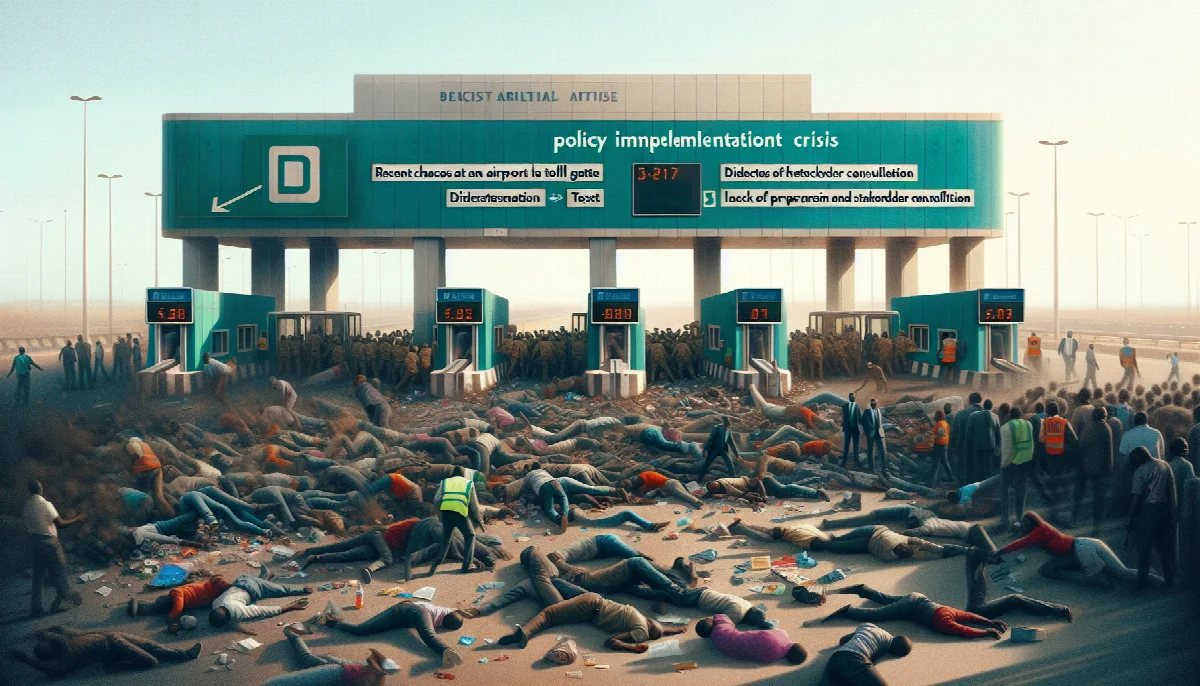
The airport access fee debacle, where motorists arriving at toll gates discovered cash payments suddenly discontinued without prior notice, exemplifies what The Nation newspaper described as "how not to implement public policy." Travelers faced confusion and delays as authorities shifted to a new payment system with no transition period or public communication strategy.
"The scene at Nigeria's airports recently was painful," The Nation reported, noting that the "long-standing practice of paying a small access fee in cash had been abruptly discontinued." The incident underscores a broader governance challenge where policy announcements precede the infrastructure and public awareness needed for smooth implementation.
The Central Bank's March 10 directive ordering banks to upgrade their systems represents another case of reform introduced without clear timelines or implementation frameworks. While The Nation editorial board praised the banking sector reforms as a "timely reset" that is "as good for the financial system as it is for general security," the directive's sudden nature mirrors the airport toll gate confusion.
These implementation failures occur as President Bola Tinubu's administration pushes multiple reforms simultaneously. Senator Adetokunbo Abiru of Lagos East defended the government's approach, stating that "his decisions, reforms have started yielding results," according to The Nation. However, the gap between policy ambition and execution capability continues to erode public confidence.
The pattern reflects what observers describe as a disconnect between Abuja's policy-making apparatus and ground-level realities. Reforms announced with fanfare regularly stumble during rollout, creating unnecessary hardship for citizens and businesses already navigating Nigeria's challenging economic environment.
Political tensions are rising ahead of the 2027 elections, with The Nation reporting concerns about "a growing climate of intolerance" despite President Tinubu's recent hosting of opposition members and his stated commitment to democratic principles. The administration's implementation struggles risk providing ammunition to critics questioning its competence.
The incidents also highlight Nigeria's weak institutional capacity for policy coordination across government agencies. Without improved inter-agency communication and mandatory public consultation periods before major policy changes, similar disruptions appear inevitable as the Tinubu administration pursues its reform agenda.