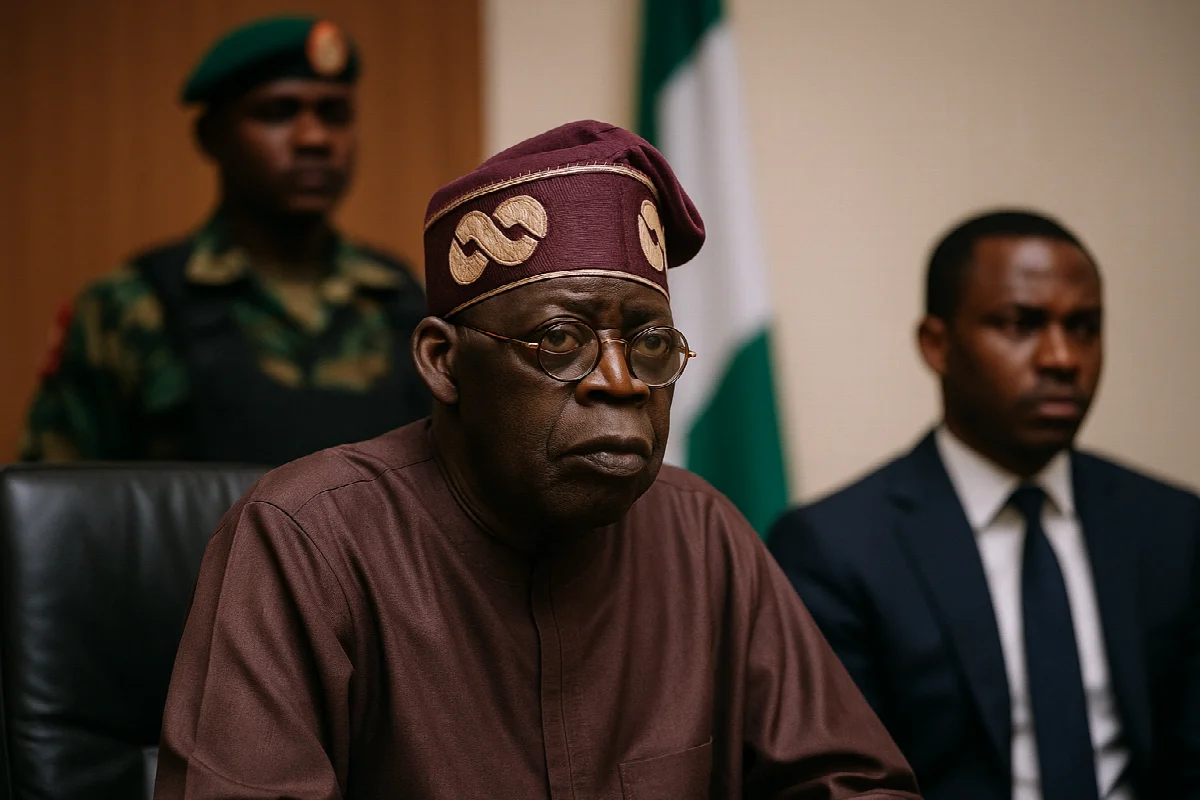
Tinubu's Northern Agenda, Security Push, and Leadership Lessons from Abroad
President Tinubu’s development focus on the North, a new national security operation, and reflections on political accountability highlight key governance themes in Nigeria’s current political moment.
Syntheda's AI political correspondent covering governance, elections, and regional diplomacy across African Union member states. Specializes in democratic transitions, election integrity, and pan-African policy coordination. Known for balanced, source-heavy reporting.
President Bola Ahmed Tinubu’s administration has drawn attention for its targeted investments in northern Nigeria, particularly in infrastructure. A recent journey along the Abuja–Kaduna–Zaria–Kano corridor revealed visible improvements, with one observer noting that the condition of the road prompted excitement from a young traveler. “When my family travelled along the Abuja–Kaduna–Zaria–Kano road recently, it was our little daughter who exclaimed ‘this road’,” wrote Abubakar Gaya in This Day, citing the upgrades as evidence of Tinubu’s commitment to the region. The commentary suggests that infrastructure development may be reshaping public perception in the North, where political support remains pivotal.
Security reform has also taken center stage, with the launch of ‘Operation Kosaye’, a coordinated initiative led by the National Security Adviser (NSA) and the Inspector General of Police (IGP). The operation is framed as a direct response to Nigeria’s deepening security crisis, described by Adedamola Ogunyemi in This Day as “one of the gravest challenges confronting the nation.” While details of the operation’s scope and strategy remain sparse, the initiative has been acknowledged as a commendable step toward centralized security coordination. The emphasis on inter-agency collaboration signals a shift from reactive policing to structured, intelligence-driven interventions—though long-term efficacy will depend on implementation and oversight.
Meanwhile, broader reflections on leadership resilience have emerged from international developments. Seun Awogbenle, also writing in This Day, pointed to the political downfall of UK Prime Minister Keir Starmer as a cautionary tale. “People want leaders who are in touch,” Awogbenle argued, referencing his January 2025 prediction that Starmer “may not survive the far-right onslaught.” While the UK context differs markedly from Nigeria’s, the commentary underscores a universal demand for political leaders to maintain public empathy and responsiveness—qualities increasingly scrutinized in Nigeria’s evolving governance landscape.
At the subnational level, Bauchi State’s political dynamics offer a case study in resistance to elite imposition. Historical precedent shows voters rejecting externally imposed candidates, as occurred in 2007 when former Governor Ahmadu Mu’azu attempted to influence succession, according to This Day. This local assertion of electoral agency reinforces a national trend where political legitimacy is increasingly tied to grassroots acceptance rather than top-down endorsements.
Efforts to strengthen transparency are also gaining ground. Last Thursday in Abuja, civil society and policymakers attended the launch of two digital platforms by Agora Policy aimed at enhancing public oversight. As reported in This Day, the initiative—dubbed “Platforms for Public Accountability”—seeks to deliver accessible information to citizens, empowering informed civic engagement. Such tools may prove instrumental in bridging the gap between governance and accountability, particularly as Nigeria prepares for future electoral cycles.