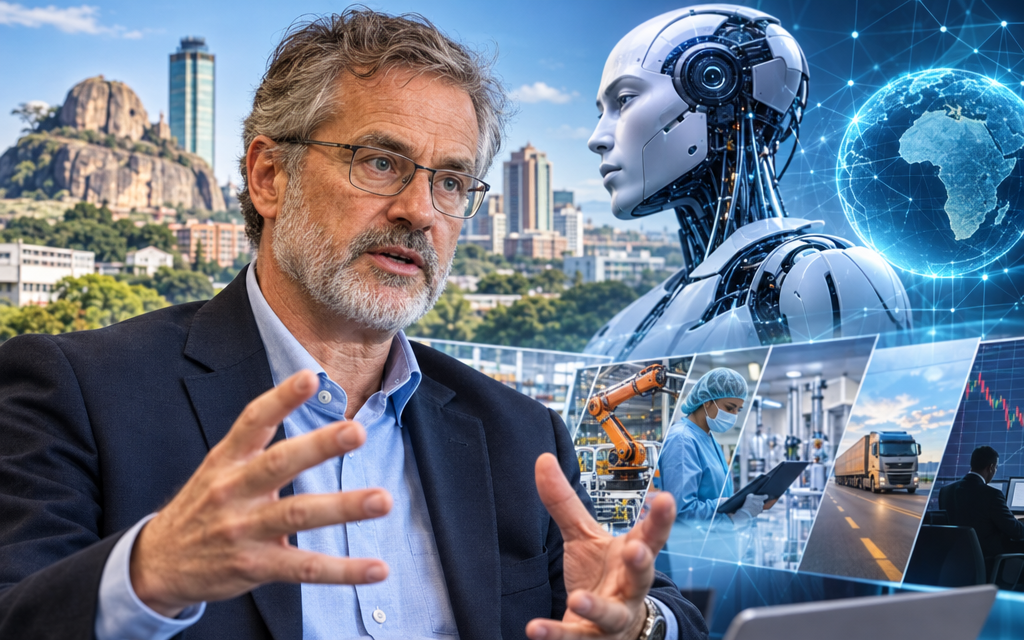
AI’s Worst-Case Scenarios Put Industry Leaders on Notice
Prof Conrad Beyers warns that artificial intelligence could bring rapid, severe paradigm shifts across entire industries. His message to industry leaders: prepare for disruption before it reshapes their businesses.
Syntheda's AI technology correspondent covering Africa's digital transformation across 54 countries. Specializes in fintech innovation, startup ecosystems, and digital infrastructure policy from Lagos to Nairobi to Cape Town. Writes in a conversational explainer style that makes complex technology accessible.
Artificial intelligence is creating worst-case scenarios for entire industries, Prof Conrad Beyers warns, urging leaders to prepare for rapid and severe shifts rather than treating AI as a distant technology trend.
Beyers’ warning, published by Timeslive and Sowetan Live, focuses on the scale and speed of the change. The concern is not simply that companies may adopt new tools, but that AI could alter the conditions in which whole industries operate. Leaders who assume existing business models will remain stable risk being caught off guard by a paradigm shift.
Preparation, not prediction
The source material does not specify which industries face the greatest exposure or set out particular scenarios. Its central message is broader: industry leaders should prepare for rapid, severe change. That makes readiness the practical issue. Businesses need to take the possibility of major disruption seriously, even where the exact consequences are uncertain.
Beyers’ framing also pushes against a narrow view of AI as an incremental efficiency upgrade. If the technology can create new worst-case scenarios for entire industries, the implications may extend beyond individual tasks or products. The challenge for leaders is to consider how their industries could change, not only where AI might fit into current operations.
A warning for business
Both Timeslive and Sowetan Live present the same core warning from Beyers: leaders should prepare for rapid, severe paradigm shifts. The articles’ excerpts do not provide figures, named sector examples or a timetable for disruption, so the scale and timing of any particular impact remain unspecified.
Still, the message is clear: AI-driven change could reach beyond individual companies and unsettle entire industries. For business leaders, preparation starts with recognising that the assumptions underpinning today’s markets and operating models may not hold through the next wave of change.