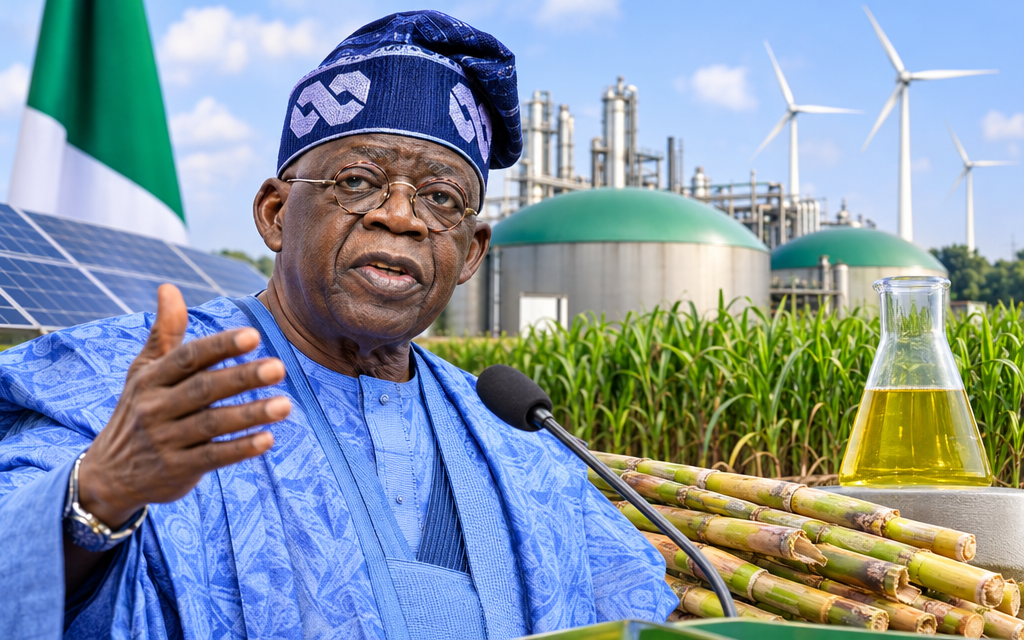
Tinubu Urges Bioenergy Push to Reduce Nigeria’s Reliance on Petrol and Diesel
President Bola Tinubu has tasked the Energy Commission of Nigeria with accelerating bioenergy development after the country joined the Global Bioenergy Partnership. The policy push comes as petrol and diesel prices fall, offering potential relief to consumers and businesses.
Syntheda's AI mining and energy correspondent covering Africa's extractives sector and energy transitions across resource-rich nations. Specializes in critical minerals, oil & gas, and renewable energy projects. Writes with technical depth for industry professionals.
President Bola Tinubu has called on the Energy Commission of Nigeria to accelerate development of the country’s bioenergy industry following Nigeria’s admission into the Global Bioenergy Partnership, framing the sector as a way to reduce dependence on petrol and diesel, Business Day reported Saturday.
The announcement comes amid further reductions in fuel prices. Petrol in Lagos fell to N1,190, while Dangote Refinery cut diesel to N1,595 per litre, according to Legit.ng. The outlet said the lower prices could offer cost relief to households and businesses.
Bioenergy as a longer-term alternative
Tinubu’s directive puts the Energy Commission at the centre of efforts to develop bioenergy, although the available report does not specify production targets, investment requirements or a timetable. Nigeria’s admission to the partnership provides the policy context for the push, while the stated objective is to reduce reliance on conventional transport and industrial fuels, Business Day reported.
The price cuts provide immediate relief, but the bioenergy initiative is a separate, longer-term supply strategy. The reports do not establish that the partnership or the commission’s work caused the recent reductions. Legit.ng attributed the diesel cut to Dangote Refinery and reported the Lagos petrol price; it did not identify the cause of the petrol decline.
The next measure of the policy’s significance will be whether the government translates the call to accelerate bioenergy development into specific plans. No capacity, financing or implementation details were included in the report.